Brasília families crowd cemeteries to honor their dead on All Souls' Day
Families from the Federal District and surrounding areas crowd cemeteries on All Souls' Day to visit graves and pay tribute to the dead, in a ritual that combines memory, faith and tradition.
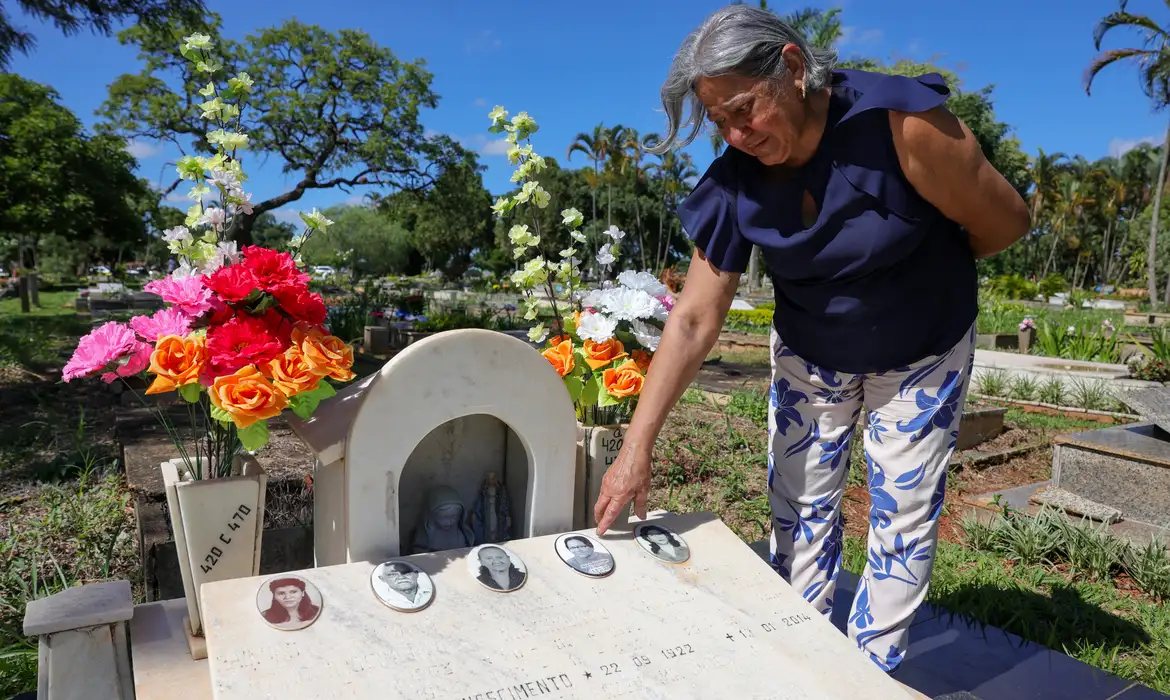
Families from the Federal District and neighboring municipalities crowded the cemeteries this All Souls' Day to visit graves, bring flowers and pay tribute to their dead. In Brasília, the movement is concentrated in places such as the Campo da Esperança Cemetery, where visitors arrive early to carry out a ritual that, for many, is repeated year after year.
Gorete Nascimento, 71, left home before 7 a.m. to carry out the ritual she has performed for 32 years. A resident of Cidade Ocidental, a Goiás municipality about 47 kilometers from Brasília, she brings flowers and cleaning products to keep the marble of the headstones spotless white. Part of her family is buried at Campo da Esperança, including her parents and three sisters. As she shows the photos of each one, she tells the story of each person. When she reaches the last one, she recalls that her sister would have turned 86 on November 6. She was not able to properly say goodbye to Angelita, who died at the start of the pandemic. "I always come here on All Souls' Day and also on each person's birthday because I miss them very much. And to honor my sister, who also never failed to come here on this date," she explained.
In the cemetery, the graves have different characteristics. The area where Gorete's family is buried is old and has tall tombs, each one unique. Meanwhile, the in-laws of Neusa Maria Nora are in the new section, where only a small plaque with a name and photo is allowed, next to a candelabra for candles. Neusa prayed for them and then sat on a bench in the shade to watch the movement. "I like to come here and remember that rich or poor, we all end up in the same place. I think people should come to the cemetery more," she said.
Marcelo Oliveira also brought flowers for his father and says he visits the cemetery many times a year, as a way to stop and let the memories come. On this day, he was accompanied by his mother and sister. His older brother could not come. "He never comes, he says he can't, he gets too emotional," he said.
The All Souls' Day tradition arrived in Brazil with Catholic Portuguese settlers. Its origin is attributed to the Benedictine monk Odilo of Cluny, of the Abbey of Cluny in France, who reportedly determined in the year 998 that the faithful should pray for the souls of the deceased on November 2, one day after the Feast of All Saints. Despite its Catholic origin, the date is also observed by Protestant Christians and by practitioners of Afro-Brazilian religions, such as Candomblé and Umbanda, who hold rituals between November 1 and 2 in honor of their ancestors.
The date was only officially made a national holiday in December 2002, through Law 10.607/2002, authored by then federal deputy Vanessa Grazziotin (PCdoB-AM).
Source: notibras.com
4