Cardinal Tagle Calls Blessed Fulton Sheen a Tireless Preacher of the Gospel at St. Louis Beatification
At the beatification Mass in St. Louis, Cardinal Luis Antonio Tagle praised Blessed Fulton J. Sheen as a missionary evangelizer who surrendered his gifts to God, served the poor, and never tired of telling the story of Jesus.
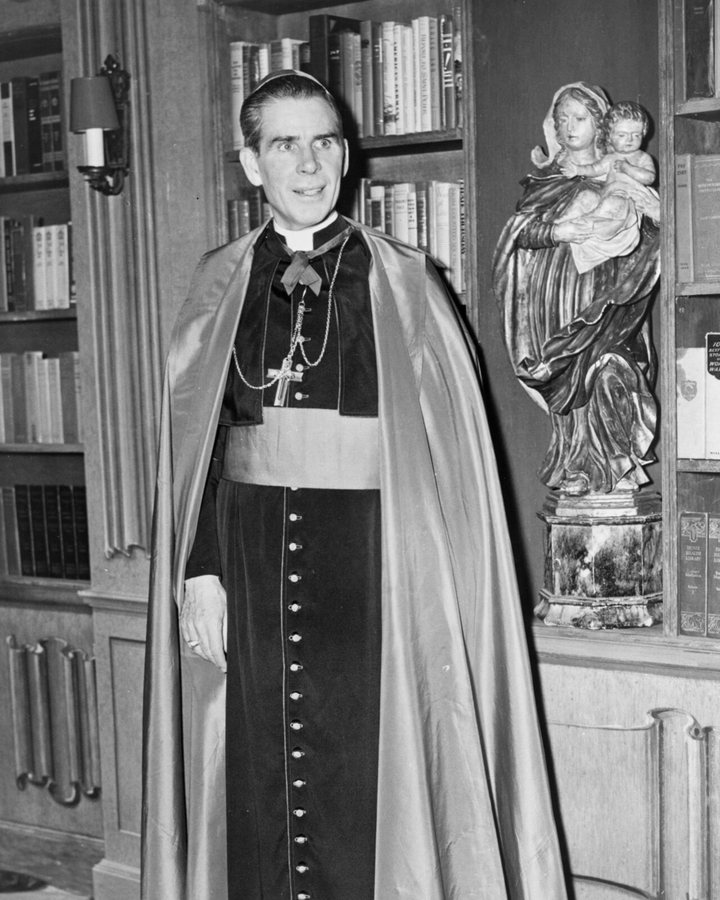
Blessed Fulton J. Sheen was a missionary evangelizer whose greatness lay not in fame or talent but in his communion with Jesus Christ, Cardinal Luis Antonio Tagle said during the beatification Mass for the American archbishop in St. Louis. The Mass, celebrated Sept. 24 at The Dome at America's Center, drew an estimated 50,000 attendees and marked the formal recognition of Sheen as blessed.
Cardinal Tagle, pro-prefect of the Holy See's Dicastery for Evangelization and archbishop emeritus of Manila, presided over the liturgy as Pope Leo XIV's delegate. In his homily, he said the pope rejoiced in the beatification of his fellow countryman and Illinoisan, and he read aloud the description of Sheen in the apostolic letter: «a tireless preacher of the Gospel through the modern means of communication, and a diligent shepherd animated by missionary zeal.»
«What a description,» Cardinal Tagle said. «Among many of his virtues and ministries, two stand out: his being an evangelizer or proclaimer of the Gospel, and his being a missionary shepherd.»
The cardinal centered his reflection on Sheen's unity with Christ, insisting that mission is not self-directed. «To choose yourself and to go wherever you want to go is not mission, and it is not blessedness,» he said. Rather, blessedness comes from surrendering one's gifts to God's will, as Sheen did with his preaching and teaching.
Drawing on the liturgy's Scripture readings, Cardinal Tagle described the missionary evangelizer as one who is known by Jesus, called to know Jesus, and invited to labor humbly with him. «Blessed are you when Jesus sees you, knows you, calls you, sends you and labors with you,» he said. «Blessed are the authentic missionary evangelizers.»
He recounted an anecdote from Sheen's life in which Pope Pius XII asked how many conversions could be attributed to his evangelization. Sheen replied that he did not count them, lest he be tempted «to believe that they were mine.» Despite his fame, Sheen saw himself as «a porter who is sometimes able to lead people to the open door of the house of God,» the cardinal said.
Sheen also told a friend who asked why he became a priest that he was called to share the Gospel and tell the story of Jesus. «I never tire of telling it; I never tire of improving my telling of it. I love my calling,» Sheen said, as Cardinal Tagle recounted. «How blessed are you, storyteller of Jesus!» the cardinal exclaimed.
Cardinal Tagle emphasized that genuine mission requires communion with concrete persons, especially the poor and vulnerable. «To use preaching as an excuse to avoid concrete persons and to be blind to God's action in them is not mission. It is not blessedness,» he said. «Blessed are you when you count yourself as an earthen vessel … so that the power may be of God and not from you.»
He noted that at the Second Vatican Council, then-Bishop Sheen urged his fellow bishops to affirm the notion of poverty and the bishops who came from poor and suffering parts of the Church. «As only a wounded Christ could convert a doubting Thomas, so only a Church wounded by poverty can convert a doubting world,» Sheen said at the council.
Sheen took up his own challenge, Cardinal Tagle said, by giving to the poor whatever remuneration he received and by promoting the missionary commitment of the Church in the United States toward poor churches worldwide. «For Archbishop Sheen, caring for the poor was not ideological propaganda, but an imperative for the following of Christ, of the joining of the Church and the missions, and of the conversion inspired by the Holy Spirit,» the cardinal said.
Blessed Fulton Sheen was a «missionary who digs deep into the heart of the poor to meet Jesus there,» Cardinal Tagle concluded. The beatification recognizes a life that combined innovative use of modern media with a shepherd's care for the vulnerable, a legacy the Church now honors as a model of evangelization for the contemporary world.
5