Pope Leo XIV to Become First Pope to Venerate Holy Tunic of Argenteuil
During his September 2026 visit to France, Pope Leo XIV will venerate the Holy Tunic of Argenteuil, believed to be the seamless robe worn by Christ during his Passion, in a historic first that highlights Christian unity.
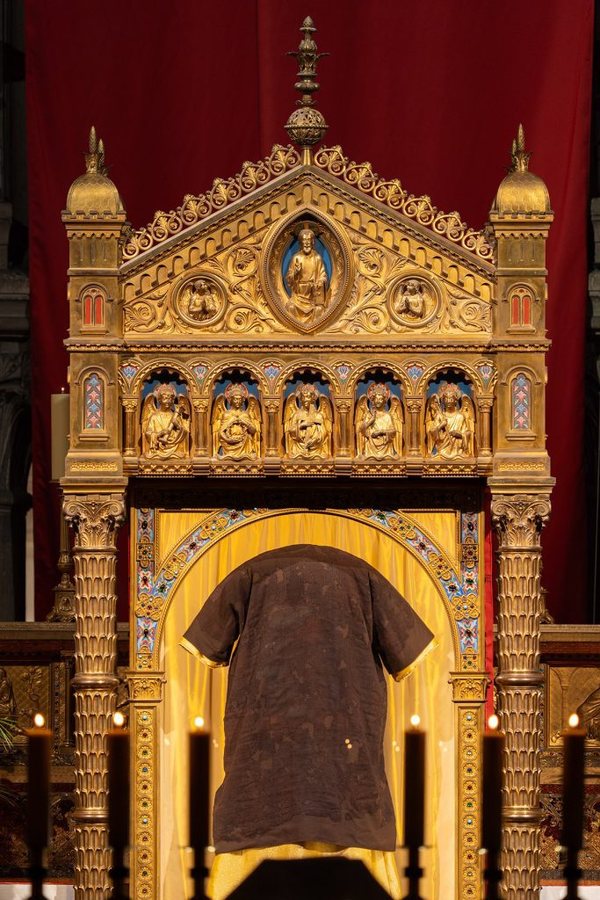
Pope Leo XIV will make history during his visit to France in September 2026 by becoming the first pope to venerate the Holy Tunic of Argenteuil, the relic long believed to be the seamless robe worn by Christ during his Passion. The tunic will be brought from its usual home in the Basilica of St. Denis in Argenteuil to the Stade de France, north of Paris, for a prayer vigil on the evening of September 25, the day of the pope's arrival.
The vigil is expected to draw 80,000 young people aged 17 to 35. Before the event, the pope will visit Notre Dame Cathedral to pray before the crown of thorns. Local authorities have described the transfer of the tunic as «exceptional», «unprecedented» and «historic». Argenteuil's official website noted that in modern times the tunic has never been officially taken out of the basilica, making this «a major first», just as Pope Leo XIV will be the first pope to behold it.
The Holy Tunic of Argenteuil has been venerated as Christ's tunic in France for over 1,200 years. Emperor Charlemagne received it around the year 800 from Empress Irene of Constantinople and entrusted it to his daughter Theodrada, who was abbess of the Abbey of Argenteuil. Over the following centuries, Argenteuil became an important pilgrimage site, attracting kings and queens eager to venerate the tunic, including St. Louis in the 13th century.
During the French Revolution, the parish priest of Argenteuil cut the tunic into pieces to hide them from revolutionaries. In the 19th century, it was almost entirely sewn back together and placed in a special reliquary inside the new Basilica of St. Denis. From then on, it was displayed for public veneration every 50 years, until after its restoration in 2016 it was decided not to wait that long between displays. In April and May 2025, the Diocese of Pontoise organized the last special public display for the Jubilee of Hope, drawing more than 200,000 pilgrims of all ages and social backgrounds.
Since July, a 39-year-old Parisian carpenter, Gabriel Hostachy, a practicing Catholic, has been preparing a special reliquary for the display aligned with the papal presence. Made of oak and linden wood, with a glass panel that allows the tunic to be seen, it is over 12 feet tall and designed to withstand any attempted break-in or theft. The tunic itself is made of brown wool, measuring 4 feet long and 3 feet wide. Recent scientific research results vary but acknowledge that the fabric is contemporary with Eastern textiles from the first centuries of the Christian era. The bloodstains on it are of the same blood type as those on the Shroud of Turin.
Originally seamless, the tunic is often presented as an opportunity to pray for Christian unity, in remembrance of the moment when Christ's clothes were divided at the crucifixion, when soldiers decided not to tear it, as the Gospel of John recalls. Bishop Benoît Bertrand of Pontoise, the «Guardian of the Holy Tunic», places great importance on Christian unity. He recalled that during the last public display, many cardinals could not attend because they were called to Rome for the conclave. That disappointment turned into intense prayer for the Church and for the future pope.
The theme of unity will be central at the stadium vigil, which will bring together young people from a wide variety of social backgrounds. A large number of young Catholics from the Diocese of Saint-Denis, known for its working-class neighborhoods with a significant immigrant population, will be present, along with some of their non-Christian friends. Many young people from Paris and other dioceses will also attend, including some who participate in charismatic communities or the Pentecost Pilgrimage from Paris to Chartres. Tickets for the vigil were snapped up within minutes of registration opening in August, and many young people will watch it on video during events organized by parishes or Catholic schools.
6