DeepMind Researchers Propose «Artificial Symbiotic Intelligence» as Alternative to Singularity
Researchers at DeepMind argue that general AI will emerge not as a single supermodel but as a network of cooperating agents and humans, with governance and institutions mattering more than model size.
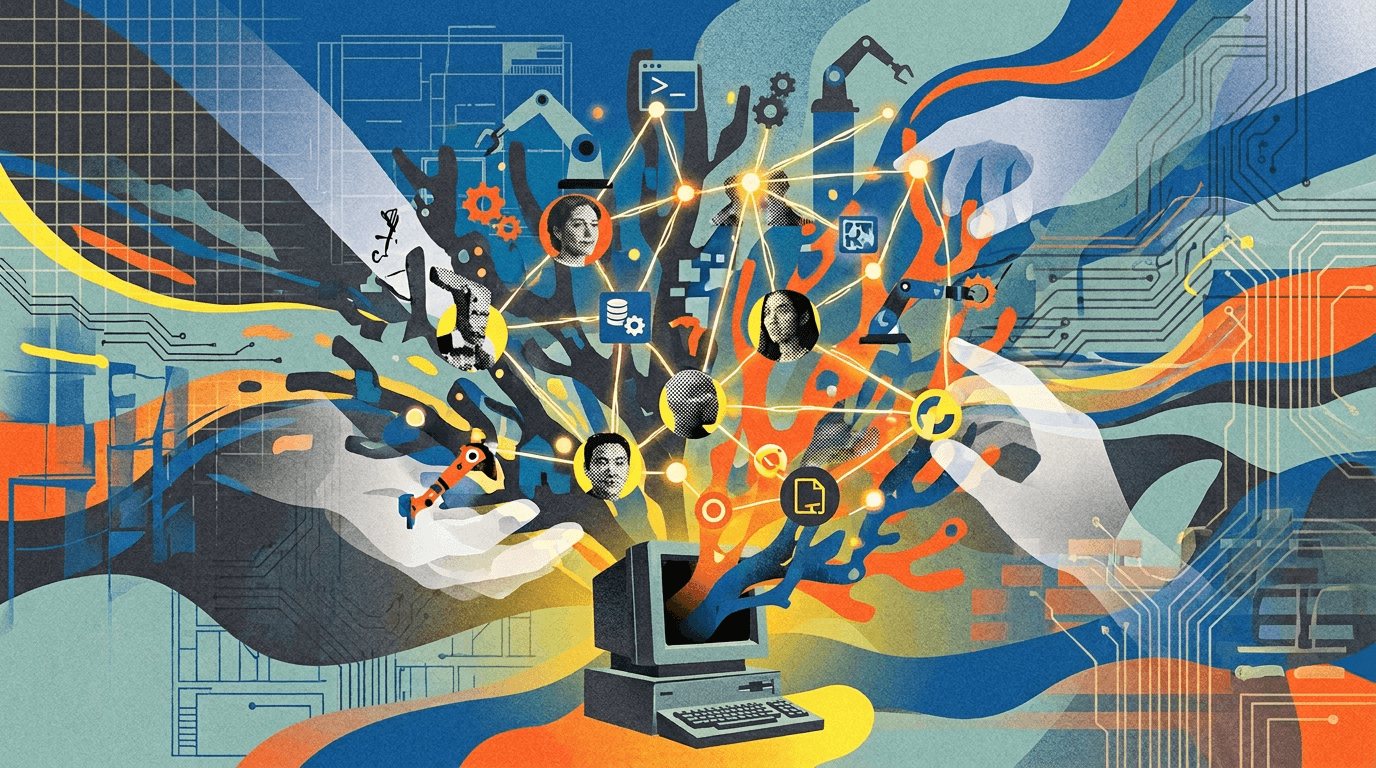
General artificial intelligence will not arrive as a single, all-powerful supermodel, according to researchers at the DeepMind Institute. Instead, they argue, it will emerge as a network of cooperating agents and humans, a concept they call «Artificial Symbiotic Intelligence.» The proposal offers an alternative to the popular singularity narrative, which envisions a sudden explosion of machine intelligence that surpasses human control.
The researchers contend that the most important factor in this emerging landscape is not the size of individual models but the rules and institutions that govern how agents and humans work together. In their view, the future of AI depends less on scaling up parameters and more on designing effective coordination mechanisms, shared protocols, and governance frameworks. This shifts the focus from raw computational power to the social and regulatory structures that shape how intelligent systems interact.
This perspective challenges the dominant trend in AI development, where massive models trained on ever-larger datasets are often presented as the path to general intelligence. DeepMind's researchers suggest that such monolithic systems may be less capable than distributed networks of specialized agents that collaborate with each other and with people. The symbiotic approach emphasizes mutual benefit and continuous interaction, rather than a single model attempting to solve all problems.
The concept of Artificial Symbiotic Intelligence also implies a more gradual and integrated evolution of AI into society. Rather than a dramatic rupture with human history, it envisions a future where AI systems are embedded in everyday life, working alongside humans in fields such as healthcare, education, and scientific research. In this scenario, the key challenges are ethical and political: how to ensure that these networks are transparent, accountable, and aligned with human values.
According to the researchers, the rules and institutions governing AI cooperation will determine whether the technology empowers or undermines human agency. They call for renewed attention to the design of incentives, norms, and oversight mechanisms that can guide the development of symbiotic intelligence. This includes questions about data sharing, decision-making authority, and the distribution of benefits among different stakeholders.
The proposal comes amid growing debate over the trajectory of AI and its potential risks. While some experts warn of existential threats from uncontrolled superintelligence, others argue that the more immediate concerns are bias, misinformation, and economic disruption. DeepMind's latest contribution leans toward the latter view, suggesting that the path to general AI is more likely to be a collaborative and incremental process than a singular event.
By framing the future as a network of cooperating agents and humans, the researchers invite a broader conversation about the kind of society we want to build with AI. Their emphasis on institutions and governance echoes longstanding debates in political philosophy and ethics, reminding us that technology does not develop in a vacuum. The choices we make about how intelligent systems interact will shape not only the capabilities of AI but also the character of our communities.
As AI research continues to advance, the idea of Artificial Symbiotic Intelligence may offer a more realistic and hopeful vision than the singularity. It suggests that the most important breakthroughs may not be in model architecture but in how we organize our collective intelligence, both human and machine. Whether this vision gains traction remains to be seen, but it adds a significant voice to the ongoing discussion about the future of AI and its role in human affairs.
6