Sakana AI's Self-Improving Model Boosts Task Performance but Cannot Detect Its Own Blind Spots
Sakana AI's MASS method allows a language model to improve itself by solving, judging, and refining tasks, reaching a nearly 70 percent win rate against its base version after two rounds. However, when the model consistently misses the same errors across all roles, it can mistake them for progress and reinforce them during training.
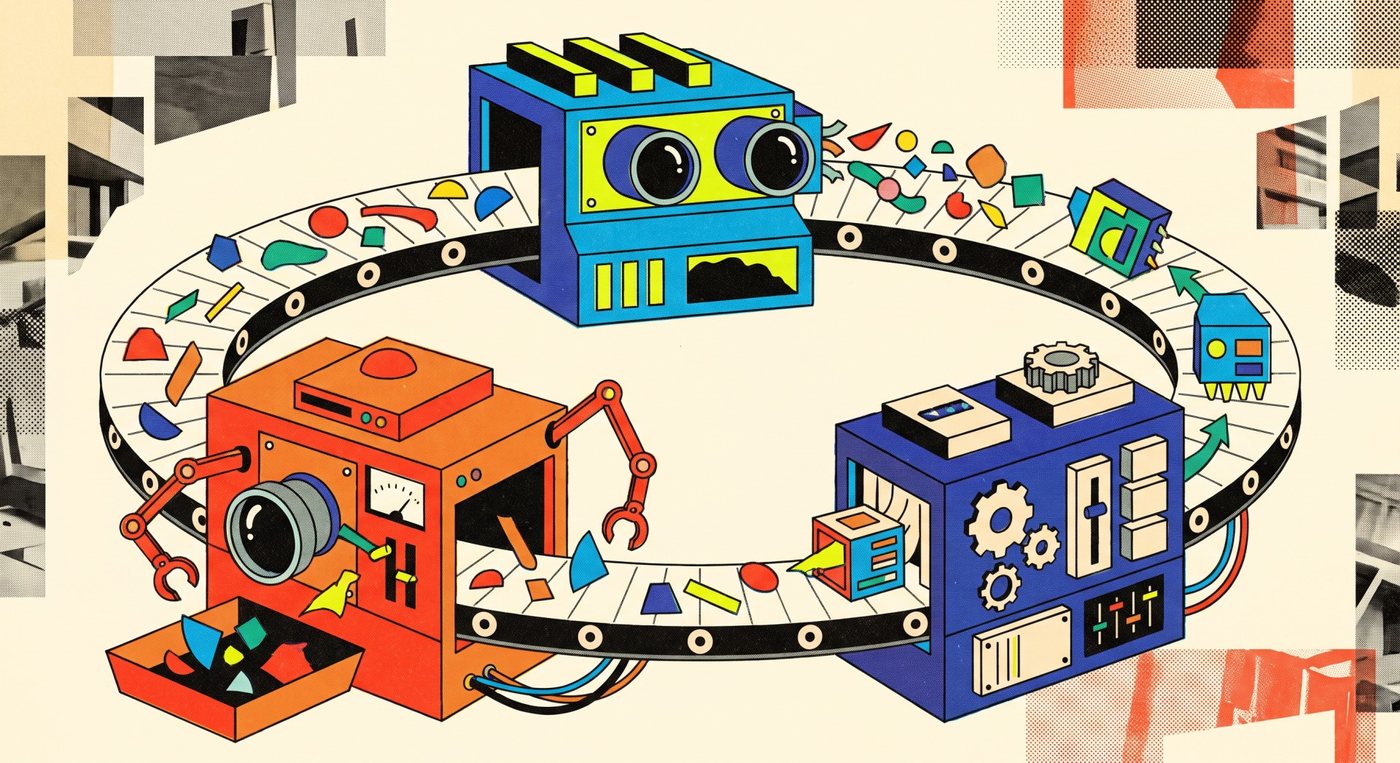
Sakana AI has developed a method that enables a single language model to improve its own performance by taking on three distinct roles: solving tasks, judging the results, and refining its workflows. Known as MASS, the approach achieved a win rate of nearly 70 percent against the base model after just two rounds of self-improvement, according to findings reported by The Decoder.
The technique represents a step toward autonomous AI systems that can enhance their capabilities without extensive human intervention. By cycling through solving, evaluating, and optimizing, the model effectively teaches itself to perform better on a given set of tasks. The substantial win rate suggests that self-improvement loops can yield meaningful gains in a relatively short time.
Yet the same research highlights a critical limitation. When the model fails to recognize the same errors across all three roles — solver, judge, and refiner — it can misinterpret those repeated mistakes as signs of progress. Instead of correcting course, the model may reinforce the errors during training, embedding them more deeply into its behavior.
This blind spot arises because the model lacks an external reference point to distinguish genuine improvement from consistent error. If the solver makes a mistake, the judge may fail to catch it, and the refiner may then treat the flawed output as a successful example to build upon. Over successive rounds, such errors can compound rather than diminish.
The finding underscores a broader challenge in the development of self-improving AI: without independent oversight or diverse evaluation mechanisms, a model's ability to judge its own work is only as reliable as its initial biases. Sakana AI's results suggest that while self-improvement can drive rapid gains, it also carries the risk of entrenching systematic flaws.
For researchers and developers, the implication is that self-improving systems may require external checks or adversarial testing to catch errors that the model itself cannot see. Relying solely on internal judgment could lead to overconfidence in flawed outputs, particularly in high-stakes applications where accuracy is paramount.
The MASS method adds to a growing body of work on recursive self-improvement, where AI models iteratively refine their own processes. While the approach achieved a notable win rate, the persistence of blind spots indicates that human oversight remains essential, at least until models can reliably detect and correct their own mistakes across all roles.
Sakana AI's research thus presents both promise and caution. The ability of a model to improve itself by nearly 70 percent against its baseline after two rounds is a significant technical achievement. But the tendency to reinforce undetected errors highlights the need for robust evaluation frameworks that go beyond the model's own judgment.
6