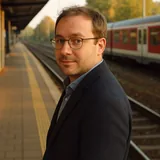
Paolo Cavallone's D'après Fauré to Premiere at Les Musicales de Quiberon
The Italian composer's new work, commissioned by festival director Pascal Gallois, receives its world premiere on 27 September in Brittany, performed by the Trio della Serenissima from the Conservatory of Venice.
The Italian composer Paolo Cavallone will see his new work, D'après Fauré, receive its world premiere at the twelfth edition of the Festival Les Musicales de Quiberon in Brittany on 27 September. The commission, signed by the festival's artistic director Pascal Gallois, marks a further chapter in a long artistic relationship between the two musicians and places an Italian voice at the heart of a programme devoted this year to French composers.
Gallois, a celebrated bassoonist, soloist, conductor and pedagogue, has played a decisive role in the contemporary repertoire for his instrument, taking part in premieres that shaped twentieth-century musical literature, from Luciano Berio's Sequenza XII to Pierre Boulez's Dialogue de l'ombre double and Wolfgang Rihm's Psalmus. Active as a conductor since 2015, he has led Les Musicales de Quiberon with a project built on dialogue between repertoire and creation, weaving the French tradition together with new compositional perspectives.
It is within that vision that the encounter with Cavallone is renewed. The commission for D'après Fauré arose from Gallois's wish to set alongside tradition a contemporary rereading, entrusting to an Italian author the elaboration of a fundamental reference point of French music. The piece takes its cue from Gabriel Fauré's Après un rêve, but Cavallone does not merely quote its memory: he shapes it, transforms it and returns it as an image observed from a shifting distance, capable of reconfiguring itself semantically. Echoes of Berio and Nono surface in the musical texture, in a play of references that turns memory into living, dynamic material.
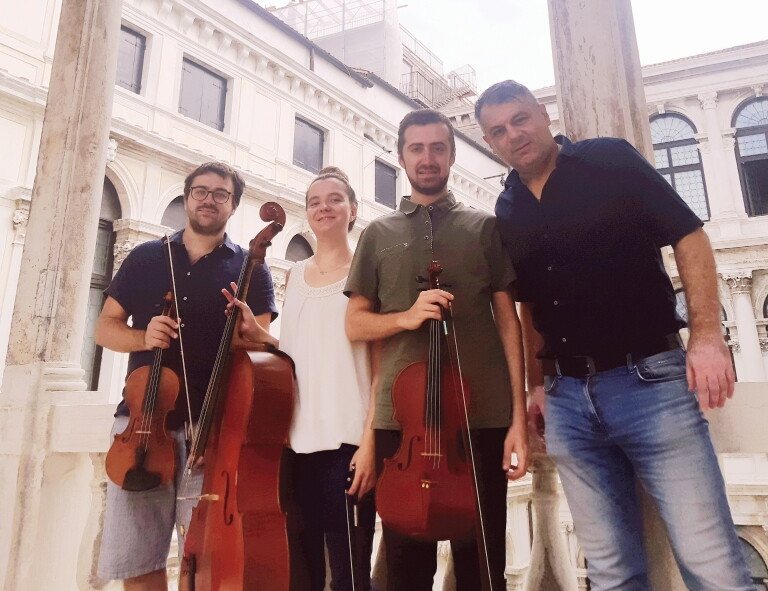
The world premiere will be entrusted to the Trio della Serenissima of the Benedetto Marcello Conservatory in Venice, formed by Carlo Maria Vianello Mirabello on violin, Leonardo Mariotto on viola and Costanza Battistella on cello. The presence of the Venetian ensemble belongs to a broader relationship between Quiberon and the Conservatory, which is guest of honour at the 2026 edition. The institution is currently led by Roberto Gottipavero, who will remain director until 31 October 2026, when Chiara Staibano takes over.
The Trio will appear twice: on 26 September with music by Darius Milhaud and Luigi Boccherini, and on 27 September with D'après Fauré, set alongside pages by Boccherini and Ermanno Wolf-Ferrari. The Venetian presence thus creates a further level of dialogue within the project: a new Italian work, born from the collaboration between Cavallone — who teaches composition at the Venice Conservatory — and Gallois, and from a confrontation with the French musical tradition, is presented in France by an ensemble linked to one of Italy's most important musical institutions.
Founded in 2015 by Gallois, Les Musicales de Quiberon have grown around the idea of pairing the great repertoire with contemporary creation. The twelfth edition, running from 25 to 27 September, will inaugurate the renovated Palais des Congrès Louison Bobet and offer a journey devoted to French music, from Couperin and Rameau to Fauré, Debussy, Ravel and Chausson. Alongside the historical repertoire, the festival will present new works by Pascal Dusapin, Olga Neuwirth and Paolo Cavallone. Neuwirth's creation, Tombeau III, will be conducted by Gallois himself, confirming the centrality of research music in the programming.
For Cavallone, the return to Brittany carries particular significance. After recent successes with the stage work Il D'Annunzio Segreto and the new CD Miroirs d'esquisses, released by Da Vinci Classics, the composer returns to a region with which he has already developed a deep artistic bond. He has previously collaborated with the Orchestre National de Bretagne on the commission and premiere of the double concerto Metamorfosi d'amore, performed at the Opéra de Rennes, as well as on the recording of Porte and the realisation of the CD Hóros, presented at Radio France. That release also contains Daimon, a 2009 trio performed by Magnus Andersson, Rohan de Saram and Pascal Gallois. The new commission for D'après Fauré therefore sits within an already consolidated artistic relationship. With Gallois, Cavallone finds in Brittany an interlocutor sensitive to contemporary creation and to building new paths between memory and innovation, confirming Quiberon as one of the liveliest places of European musical dialogue.