Youth Rally in More Than 30 German Cities Against Austerity
Under the name »Gen Z regelt«, young people have called for nationwide protests. They demand more funding for education, support services and climate protection, and reject compulsory military service.
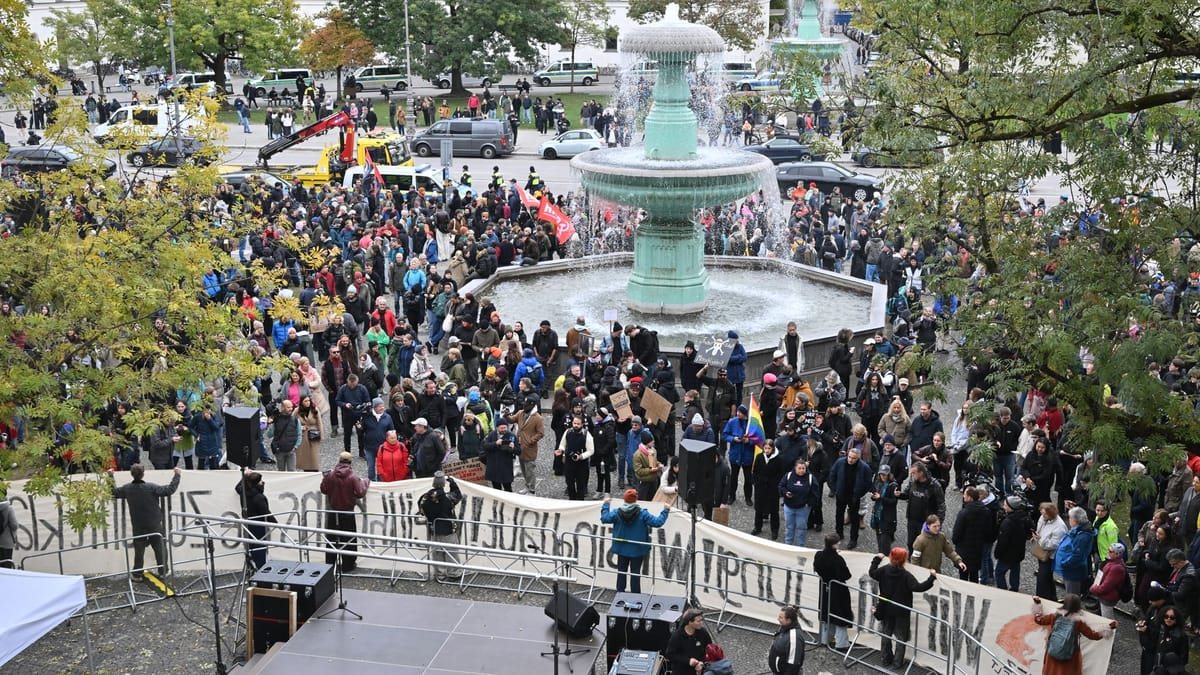
Nationwide youth protests began on Wednesday in more than 30 German cities. In Berlin, Frankfurt am Main, Hamburg, Munich, Dresden, Leipzig and other cities, several hundred people each gathered at the start of the protests in the early afternoon. In some cities there were delays, and nationwide participant numbers were initially not available.
The initiative »Gen Z regelt« had called for the demonstrations. It demands more money for schools, addiction support and psychotherapy, measures against rising living costs, social justice and more climate protection. The group rejects compulsory military service as well as an expansion of state surveillance. By the start of the protests at 2 p.m., more than 182,000 people had indicated on the initiative's homepage that they wanted to take part. The officially registered participant numbers in the cities were significantly lower. How many would actually turn up was initially unclear.
In Berlin, according to police, around 650 people gathered at the Brandenburg Gate; the organizers initially gave no figure. In Munich, according to police, about 1,000 people had come together, and in Nuremberg, according to on-site reports, many participants were on the move and the mood was relaxed. At a rally near the European Central Bank in Frankfurt, police initially counted more than 1,500 participants, and in Mainz 1,200. In Freiburg, the police spoke of 2,500 participants. A police spokesperson in Mainz said everything was proceeding peacefully.
The organizers emphasize the peaceful nature of the protests and reject any form of violence. They do not want extremist groups or unconstitutional symbols at the demonstrations and warn against glass, weapons and provocations directed at the police. Many retailers in city centers, especially on luxury shopping streets in larger cities, had boarded up their shop windows with wooden panels out of fear of riots. In some places, shops remained closed anyway due to Reformation Day.
According to the Federal Interior Ministry, the federal security authorities had no further information about calls for violence or planned riots. However, parts of the left-wing extremist scene, as well as isolated groups from foreign-related extremism, had taken up the calls in order to join the mobilization. In some places the police were present with several hundred officers, and in Hamburg drones were also to be deployed. Representatives of »Gen Z regelt« criticized the strong focus on concerns about violence. One organizer said this showed that the group was not being taken seriously, because no one was engaging with its content.
The Federal Pupils' Conference distanced itself from the protest and pointed to »opaque organizational structures«. The initiative itself distances itself from individual events that also refer to it. On social media there are numerous posts and channels related to the group, but not all of them speak on its behalf. The demonstrations in Berlin, Cologne, Frankfurt and Munich are supported by an organizing team around »Gen Z regelt«; at the other locations the group said it was not responsible, but its website refers to these events.
Katharina Dröge, parliamentary group leader of the Greens in the Bundestag, expressed understanding for young people's anger. She told the German Press Agency that young people were rightly angry because the federal government did not take their concerns seriously enough and continued to owe them answers. The Left Party supports the protests. Party chairman Luigi Pantisano spoke of the right time for protests and pointed to planned reforms in care and pensions, which he described as »social cruelties«. AfD leader Alice Weidel, by contrast, warned against being hijacked by extremists. There was a real danger, she said, that the demonstrations, as in France, would be taken over by violence-prone people from the far-left and Islamist milieus.
9