In Prague, a Bell Made From Weapons Rings for Ukraine’s Freedom
A church that lost a bell to wartime requisition now has one made partly from Russian weapons used against Ukraine, inscribed with a line from Galatians about freedom and slavery.
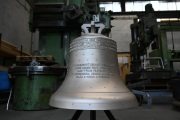
A bell in central Prague carries an unusually literal theology of reversal. More than a century after a bell from the Church of the Holy Saviour was taken for wartime use, a new bell has been installed there using metal from weapons connected to Russia’s war against Ukraine. On 24 August 2026, it rang for the first time specifically to mark Ukraine’s Independence Day.
The ceremony took place beside the Church of the Holy Saviour near Charles Bridge. Ukraine’s ambassador to the Czech Republic, Vasyl Zvarych, and the Dutch ambassador, Mina Noor, rang the Bell of Freedom. Around sixty people attended, singing the Ukrainian and Czech national anthems and unfurling a 30-metre Ukrainian flag.
The bell itself was cast in the Netherlands by Royal Eijsbouts. Material associated with a seven-kilogram artillery projectile and fragments of an S-300 missile from Ukraine were incorporated into the project. The finished bell measures 69 centimetres across and weighs more than 220 kilograms.
Its inscription gives the object its clearest religious language. In Ukrainian, Czech and Dutch, the bell carries the injunction: “Stand firm in freedom and do not submit again to a yoke of slavery.” The wording is drawn from Galatians 5:1, where Paul’s language of freedom and bondage belongs to a theological argument about life in Christ. On a bell containing metal from modern war, the verse also acquires an unavoidable political and historical resonance.
That resonance was built into the project from the beginning. The initiative came from the Embassy of the Netherlands in the Czech Republic and Sanctus Castulus, an association dedicated to returning missing bells to Czech churches. The Ukrainian Embassy joined as a project partner, while Huisman Czech Republic became the principal sponsor. The bell was formally handed over to the parish on 5 June 2025 in the presence of Queen Máxima of the Netherlands, Czech President Petr Pavel and First Lady Eva Pavlová. Priest and theologian Tomáš Halík blessed it.
The choice of church was not incidental. One of the Holy Saviour’s historical bells was requisitioned during the First World War, part of a wider practice in which church bells were removed and reused for military purposes. Bell metal became war material. The Bell of Freedom is intentionally the opposite movement: material from weapons is returned to a sacred space and given a voice.
That reversal matters because Christian symbolism here is carried by a physical object rather than an abstract slogan. The bell still performs the ordinary work of a bell. It sounds in a living church, within the rhythms of worship and civic life. Yet every account of its making points back to the violence from which part of its material came.
The three languages inscribed on the bronze also prevent the object from belonging to only one national story. Ukrainian names the country whose experience of war gives the bell its immediate meaning. Czech situates it in the city and parish that received it. Dutch recalls the country in which it was cast and the diplomatic initiative that helped bring the project into being.
That reversal is powerful precisely because it is incomplete. The war from which the metal came is not over. Among those present on 24 August was Ukrainian servicewoman Viktoria “Runa” Kovbasiuk, who was on leave in the Czech Republic and collecting aid for the military. Her presence prevented the bell from becoming a comfortable memorial to a finished conflict. It is a religious and cultural symbol created while the violence it addresses is still ongoing.
Ukraine marked the 35th anniversary of its independence that day. The date placed the biblical language of freedom beside a modern national struggle that remains unresolved. The ceremony therefore did not ask listeners to choose between religious, historical and political meanings. All three were present in the same object and the same sound.
Church bells traditionally order communal time. They call people to worship, mark mourning and celebration, and make the presence of a community audible beyond the church walls. This bell adds another layer. Its sound does not erase the previous purpose of its material; instead, the memory of violence becomes part of what listeners are asked to hear.
The Bell of Freedom will continue to ring in Prague after the Independence Day ceremony has passed. Its biblical inscription will remain fixed on the bronze, and the history of the missing wartime bell will remain part of the building. What has changed is the direction of the metal’s journey: once, a church bell was turned toward war; now, remnants of war have been turned toward a church and made to speak of freedom.
69