The third wave: How Ukrainian exile is changing Western Orthodoxy
Ukraine’s post-2022 migration has created new Orthodox parishes across Germany and the United States, often inside Catholic and Protestant spaces. The long history of the diaspora suggests what may happen when an ethnic church becomes a church of neighbours.
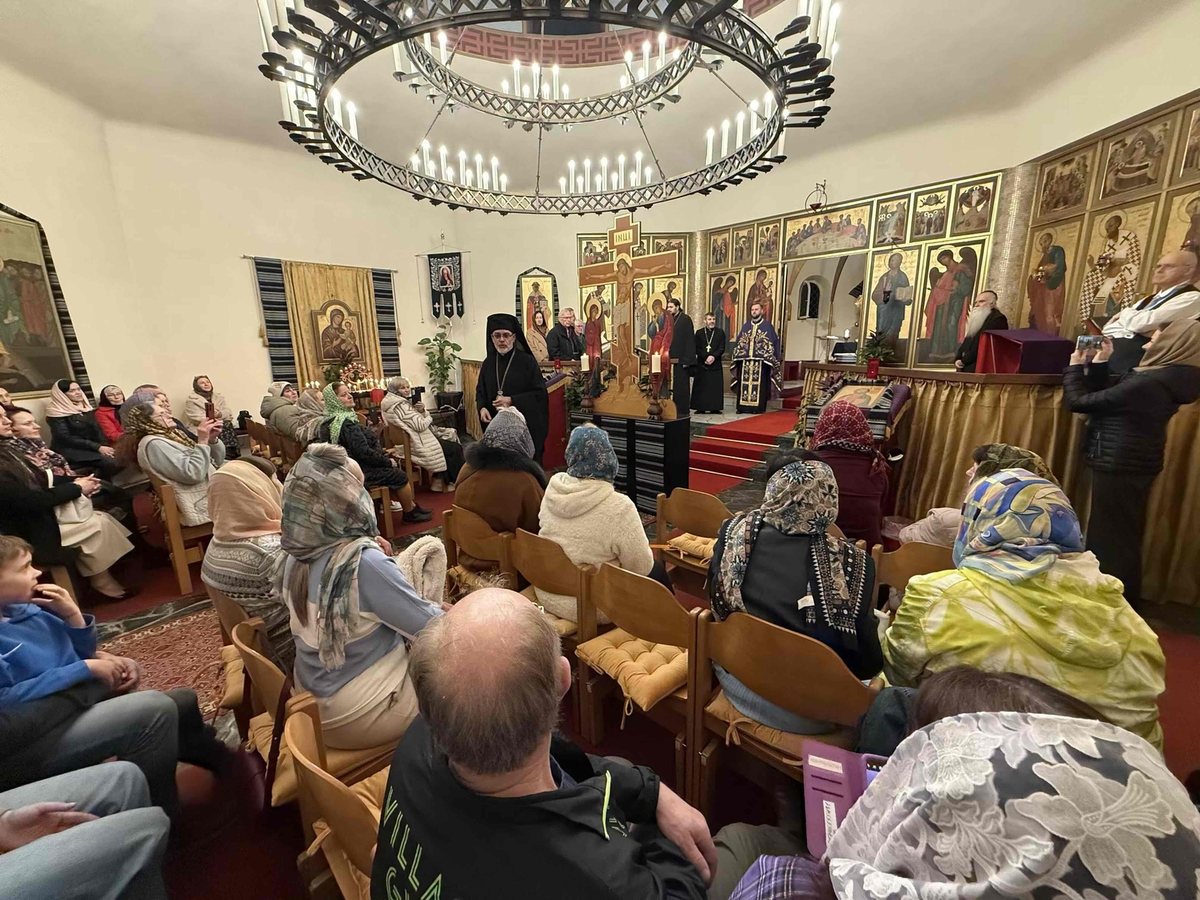
In Palatine, a suburb of Chicago, the change can be seen in one building.
For 170 years, a United Church of Christ congregation worshipped there. On August 17, 2025, the same sanctuary also became the spiritual home of the Holy Archangel Michael Ukrainian Orthodox Mission. The Ukrainian Orthodox Church of the USA described a congregation filled with recent arrivals from Ukraine, including families and children, and publicly thanked the Protestant community for opening not only its church but other parish facilities.
It is a small local story with a much larger implication. The latest Ukrainian migration is not merely transporting Orthodoxy from one country to another. In parts of Europe and North America it is placing Orthodox worship physically inside spaces built and maintained by Catholics and Protestants, while newly formed parishes learn to live in the languages and social rhythms of their host societies.
That process is especially visible in Germany. Nikolaj Thon, a former general secretary of the Orthodox Bishops’ Conference in Germany, estimated that at least 750,000 Orthodox Christians had arrived in the country from spring 2022 onward. The figure is an estimate, not a census of Ukrainian believers, but church observers agree on the underlying change: the number of Orthodox Christians and the number of Ukrainian Orthodox communities rose sharply after Russia’s full-scale invasion.
The institutional response followed quickly. At a 2024 gathering of the Ukrainian Orthodox Church in the Diaspora, church leaders spoke of 30 new Ukrainian Orthodox parishes in Germany. By July 2026, a Western European eparchial assembly in Munich brought together clergy and lay representatives from more than 35 Ukrainian Orthodox communities in Germany and other parts of Western Europe.
Many of these communities did not begin with a purpose-built Orthodox church. German Protestant and Catholic congregations have provided rooms and sanctuaries for Ukrainian worship. In Württemberg, for example, the regional Protestant church has described a Stuttgart congregation that has made its church available for weekly Ukrainian Orthodox services. The pattern is practical before it is theological: refugees need a place to pray, established churches have buildings, and local Christians decide to share them.
Yet the consequences are not purely practical. Shared space changes who sees whom.
A Protestant volunteer who first meets Ukrainians through refugee assistance may later encounter an Orthodox priest in a familiar church building. Children grow up among classmates who know that their family attends a Byzantine liturgy. Mixed families bring spouses who may not speak Ukrainian. Neighbours arrive out of curiosity. The distance between “Eastern Christianity” and ordinary Western life becomes shorter simply because the people involved now share streets, schools and church corridors.
Krefeld offers a particularly clear example of what comes next. The Protection of the Mother of God Ukrainian Orthodox parish says that its liturgy is celebrated in Ukrainian and German. Its own website explicitly welcomes not only Orthodox believers but also “Interessierte und Suchende” — people who are interested or searching.
That language matters. An immigrant parish can remain primarily a shelter for people who already belong to it. A bilingual parish that consciously welcomes seekers begins to operate differently. It can still preserve Ukrainian memory, music and ritual while also becoming intelligible to a German who has no Ukrainian background at all.
North America shows that this transition is not unprecedented.
The Ukrainian Orthodox Church of the USA traces its institutional roots to the early twentieth century. After the Second World War, its own history records another major expansion as immigrants from displaced-person camps in Germany founded and joined parishes in the United States. The first generation needed a church that could preserve faith and identity after displacement. Later generations had to decide how much of that church would remain tied to the language of their parents and grandparents.
The post-2022 migration has opened another chapter. Migration Policy Institute estimates show more than 510,000 Ukraine-born immigrants living in the United States in 2024, up 28 percent from 2021. By March 2025, about 240,000 Ukrainians had received humanitarian parole through Uniting for Ukraine. Those arrivals joined older Ukrainian communities concentrated in metropolitan areas including New York, Chicago and Seattle.
Church infrastructure has begun responding again. The Ukrainian Orthodox Church of the USA’s 2025 Sobor identified new missions in Charlotte, Palatine and Philadelphia, while describing plans for missions in Denver and Atlanta. In Charlotte, a community that began as a small home chapel developed into a mission with plans for catechetical classes and outreach to recently resettled refugees. The church’s own account notes that liturgical Slavonic now mingles with English.
That sequence is familiar in immigrant religious history: people arrive, a community gathers, a parish takes shape, and the local language enters. What matters is what happens after that. Once English or German becomes normal in worship and parish life, the community no longer requires an ethnic passport to be understood.
The American religious environment makes this question especially interesting. Pew Research Center’s 2023–24 Religious Landscape Study found that 35 percent of U.S. adults now identify with a religion, or with no religion, different from the one in which they were raised. The United States remains 62 percent Christian, including 40 percent Protestant and 19 percent Catholic, while Orthodox Christians account for about 1 percent of adults.
That does not mean American Protestants and Catholics are converting to Orthodoxy because Ukrainian refugees have arrived. The available data do not support such a claim. Pew measures religious switching at the national level but does not identify a refugee-driven Orthodox conversion effect. Orthodox church sources document missions, inquirers and outreach, but they do not provide a post-2022 conversion count that could establish causation.
Still, American Orthodoxy has long treated openness to newcomers as a serious institutional question. In 2017, the Assembly of Canonical Orthodox Bishops of the United States released the first national study of evangelisation and outreach in American Orthodox parishes. Seven jurisdictions participated. The report examined, among other things, how successful parishes welcome first-time visitors and people inquiring about the faith.
The Ukrainian case therefore sits inside a broader American pattern: ethnic Orthodox churches gradually learning how to receive people who were not raised inside them.
Canada shows the same tension from another angle. The federal government recorded 298,128 arrivals under the Canada-Ukraine Authorization for Emergency Travel between March 2022 and April 2024. They entered a country in which the 2021 census found 53.3 percent of the population identifying as Christian, 29.9 percent as Catholic and 1.7 percent as Orthodox.
The Ukrainian Orthodox Church of Canada has been debating language for much longer than the current refugee wave. On its official website, an essay on liturgical language says openly that the church must understand itself as a “Mission Church.” Its argument is practical and generational: English, and French in Quebec, are necessary not only for converts but for children raised in Canada, non-Ukrainian spouses and neighbours. The author even imagines a future in which English- or French-language parishes could be founded by people shaped by the Ukrainian Orthodox tradition but no longer dependent on Ukrainian as their everyday language.
South America reveals what the far end of that process can look like. Ukrainian Orthodox communities in Brazil, Argentina and Paraguay are now generations removed from the migrants who established them. At the 17th Sobor of the Ukrainian Orthodox Eparchy of South America in Fram, Paraguay, in 2025, 67 delegates represented parishes from all three countries. The church’s leaders did not speak only about preserving an inherited culture. They urged the faithful to understand their work as part of the universal mission of Orthodoxy and to strengthen unity between Ukrainians and the peoples among whom they live.
This long view is essential. An immigrant church begins with preservation for a good reason. Displaced people often need a place where language, memory, family rituals and faith remain recognisable. But if the church survives for generations, preservation alone becomes insufficient. Children become bilingual. Marriages cross ethnic lines. Local-born parishioners may understand the faith better in English, German, French, Spanish or Portuguese than in Ukrainian. The church either develops a language for them or slowly becomes a monument to an earlier migration.
After 2022, that generational process has been compressed. Ukrainian refugees did not settle in isolated colonies. They entered existing European and North American cities, schools, workplaces and neighbourhoods. Their parishes are forming inside dense networks of daily contact. In some cases, they did not even need to build the first walls themselves; other Christians lent them walls that already existed.
This is why the most important evidence is not yet a conversion statistic. It is infrastructure.
A Protestant sanctuary in Illinois becomes home to an Orthodox mission. A German parish alternates Ukrainian and German in the liturgy. A Charlotte mission combines Slavonic and English. A Canadian church argues that mission requires the languages of the country. A South American eparchy tells the descendants of immigrants to carry their faith beyond the ethnic community.
None of this proves that a large Western turn toward Orthodoxy has begun. It does show that the conditions under which people encounter Orthodoxy are changing. A tradition once experienced by many Western Christians as distant and ethnic is becoming a neighbour, a schoolmate’s church, a spouse’s parish, or the liturgy taking place in a building they already know.
The third wave of Ukrainian Orthodox migration was not launched as a missionary project. It was created by war and displacement. But churches are institutions that outlive the circumstances in which they were founded. The decisive question may therefore be asked ten or twenty years from now: whether today’s refugee parishes remain primarily Ukrainian shelters abroad, or become local Orthodox communities whose Ukrainian inheritance is a starting point rather than a boundary.
62