US bishops advance AI, pro-life and youth plans at Baltimore meeting
At their fall plenary assembly in Baltimore, US Catholic bishops approved liturgical texts and financial guidelines, heard a Catholic University survey on young adults, launched an AI task force, and moved to update their pro-life pastoral plan.
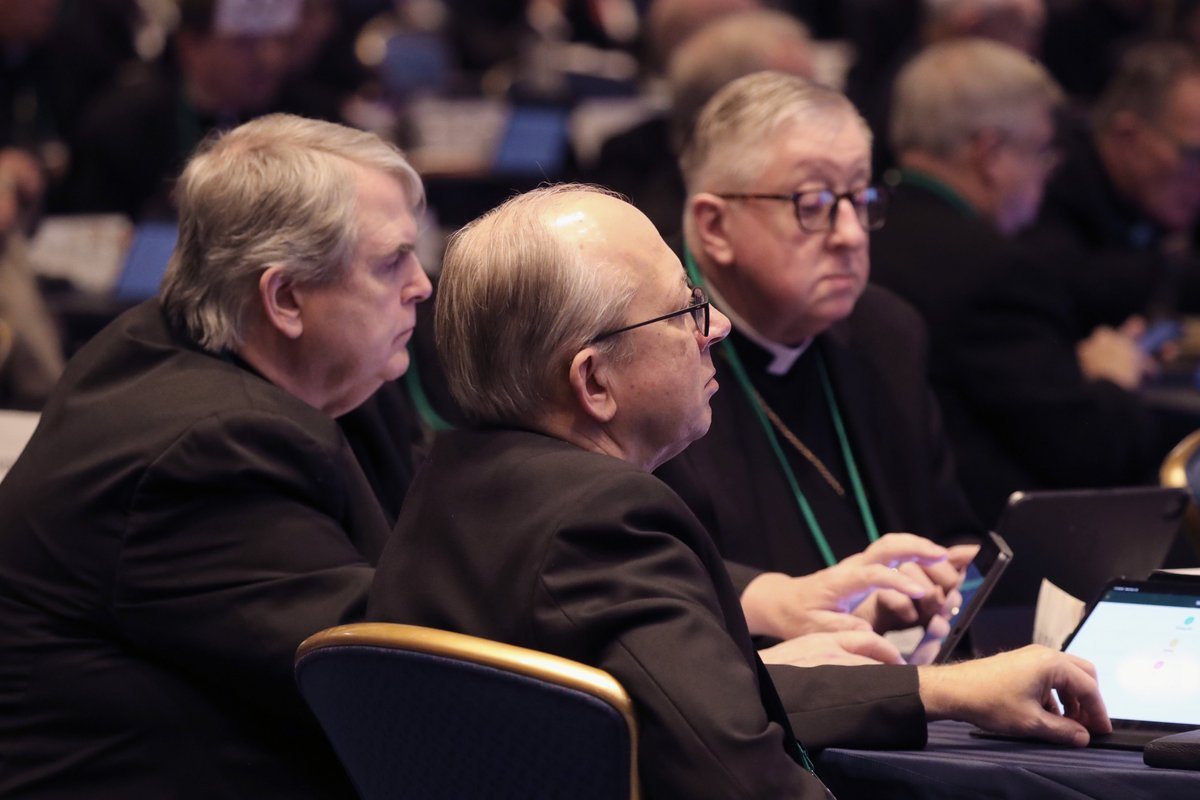
US Catholic bishops used the second day of public sessions at their fall plenary assembly in Baltimore to take up the evangelization of young adults, the challenges posed by artificial intelligence, a revised pro-life pastoral plan, and a call for prayer against racism and solidarity with immigrants. The meeting, held November 16 to 19, opened with a quick round of votes on items discussed the day before.
On the morning of November 18, the bishops voted overwhelmingly, without amendments, to approve a new Mass lectionary and Book of the Gospels. The texts are designed to harmonize the readings heard at Mass with those found in the forthcoming Catholic American Bible. The assembly also approved a resolution on diocesan financial reporting through 2031 and an updated Socially Responsible Investment Guidelines document for the United States Conference of Catholic Bishops.
Archbishop Charles C. Thompson of Indianapolis, chair of the Committee on Evangelization and Catechesis, introduced Auxiliary Bishop Richard Umbers of Sydney, who spoke about the 2028 International Eucharistic Congress in Sydney. The congress takes as its theme «This is my body given for you.» Bishop Umbers said the Sydney planning has drawn heavily on the American experience with the National Eucharistic Revival and the 10th National Eucharistic Congress. In keeping with a request from Pope Leo, the congress will give special priority to young people. He stressed that the theme concerns the Real Presence and also what Christ does for humanity, so that believers may become more Christ-like in giving themselves to others.
After lunch, the focus shifted to young adults. A panel of experts from The Catholic University of America presented research on Catholics under 30. Brandon Vaidyanathan, a professor of sociology at the university, opened with findings from Gallup's 2026 Beauty and Belief survey, conducted in March and April 2026. According to the data, 64 percent of Catholic young adults say religion is more important to them now than it was five years ago, compared with 41 percent of Catholic adults over 30. Vaidyanathan and his colleagues answered bishops' questions afterward and made clear that the Church is still «pretty far away in terms of revival.»
The presentation found that the younger generation is less likely than older Americans to describe itself as «spiritual» and more likely to describe itself as «religious but not spiritual.» Young men and women under 30 are equally likely to consider themselves religious, though men tend to gravitate toward identity while women gravitate toward the interior life. Respondents reported a strong desire for community and moral guidance. The study also noted that 58 percent of Catholics aged 18 to 29 are Hispanic, yet they attend Mass weekly at a lower rate.
Bishop Oscar Cantú of San Jose, California, home to Silicon Valley and a hub of AI development, gave the bishops an update on the USCCB's new Task Force on Preserving Human Dignity in the Age of Artificial Intelligence, which he chairs. He acknowledged that some bishops fear AI poses an existential threat to humanity, but said the moment «represents a significant opportunity for the Church.» He compared it with the Church's response to industrialization after Pope Leo XIII's 1891 encyclical «Rerum Novarum,» and with Pope Leo XIV's 2026 encyclical «Magnifica Humanitas» on the technological revolution driven by AI. «The Church therefore has a duty similar to the one it embraced in 1891: not to reject progress, but to insist that progress remain ordered to the human person,» he said.
Cantú said the task force has begun work in several areas: formation for bishops and diocesan leaders on AI, support for Catholic education in AI literacy and best practices, public policy advocacy with the USCCB government relations team for clear guardrails on the development and use of AI, continued engagement with the technology sector, and the development of a «theology of human dignity for the digital age.»
Bishop Daniel E. Thomas of Toledo, Ohio, chair of the Committee on Pro-Life Activities, asked the bishops for permission to begin updating their pastoral plan on pro-life activities, last revised in 2001. He pointed to major changes since then, including the overturning of Roe v. Wade in 1973 and the teaching on human life from three popes after St. John Paul II, covering the death penalty and other end-of-life questions. He also noted that abortions are on the increase, that abortion pills are widely available, and that in vitro fertilization and other artificial reproductive technologies are growing more common.
Source: angelusnews.com
33