US bishops open fall assembly in Baltimore calling for unity and mission
Catholic leaders at the USCCB fall plenary in Baltimore stressed communion with the pope, a shared mission of hope, and renewed dialogue within the Church.
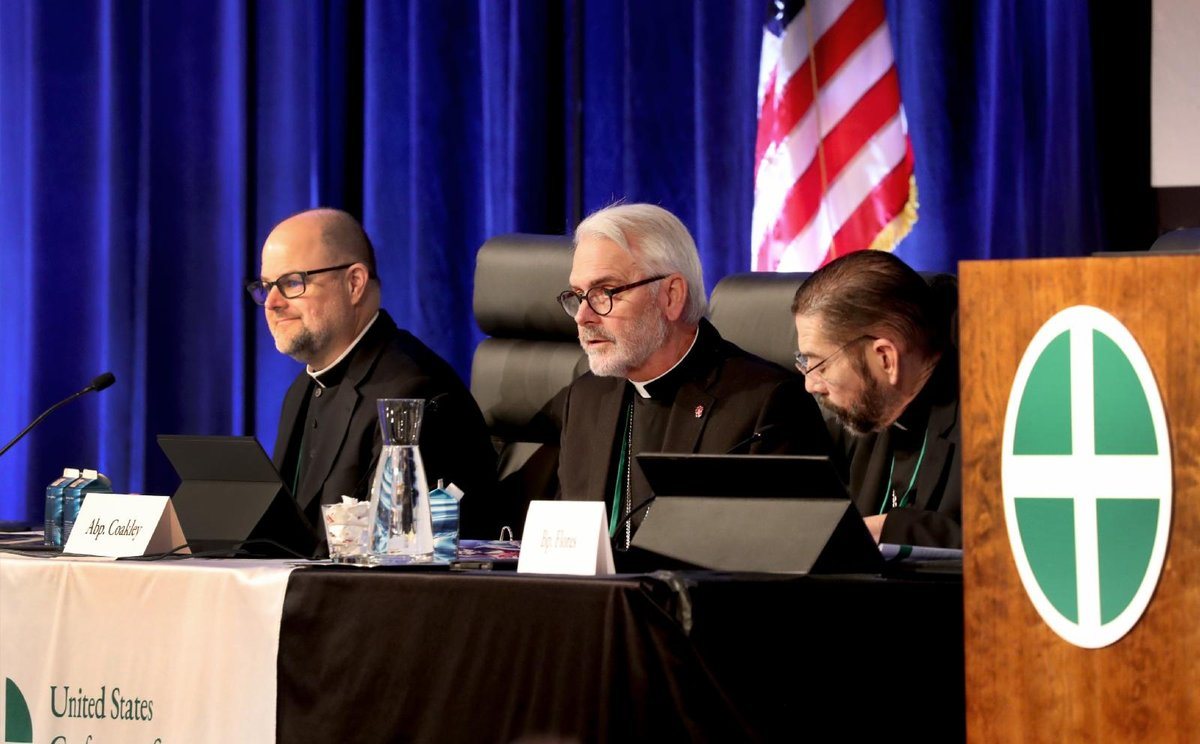
Communion and unity stood at the centre of the messages delivered as the U.S. Conference of Catholic Bishops opened its fall plenary assembly in Baltimore on November 17. Speaking to bishops gathered from across the country, conference president Archbishop Paul S. Coakley of Oklahoma City called for a renewed sense of shared mission, while Archbishop Gabriele G. Caccia, apostolic nuncio to the United States, emphasised the bishops' unity with Pope Leo XIV as successors of the apostles. The assembly runs from November 16 to 19 at the Baltimore Marriott Waterfront hotel.
Archbishop Coakley said the political terms applied to the recent U.S. midterm elections cannot accurately describe the state of the conference, the Church in the United States or the Church in the wider world. He acknowledged that many within the Church use those ideas and categories to interpret events through political or ideological lenses. «[T]he world thinks in terms of power,» he said, describing a world of yes or no, left or right, red or blue. «But, as you know and I know, the Church thinks in terms of mission,» he added.
To illustrate that mission, Coakley drew on two contrasting biblical building projects that Pope Leo XIV used in his encyclical Magnifica Humanitas: the Tower of Babel and the walls of Jerusalem rebuilt under Nehemiah. The first, he said, is a worldly project that leads to confusion, isolation and dehumanising violence, while the second is a construction site of hope. He quoted the words of the prophet Jeremiah, promising plans for welfare and not for woe, and said that in a world marked by isolation, depression, confusion and anger, the Church's task is to act as a construction site of hope rooted in Christ and his promise.
The USCCB president identified four overlapping areas where he said the Church is already working: rebuilding the family, worship, synodal dialogue and discernment, and civic life. On family, he called for the promotion of strong, sacramental marriages and pointed to the catechumenate model as a helpful approach. On worship, he praised the varied fruits of the 2022–2025 National Eucharistic Revival, including the National Eucharistic Pilgrimage and the 10th National Eucharistic Congress, and said the work should be built upon with intensive liturgical formation for clergy and laity alike.
On synodality, Coakley spoke of the rediscovery of dialogue and discernment, urging that they be practised as authentic exchange rather than buzzwords. He referred to the worldwide Synod on Synodality held between 2021 and 2024 and encouraged bishops to develop these skills as they continue to receive and implement its fruits. On civic life, he argued that polarisation, isolation and anger in communities and even families can only be overcome when people rediscover a shared hope, grounded in a common understanding of the dignity of human life and each person. He also named artificial intelligence as one of the challenges the Church must come to terms with. He told his fellow bishops that the state of the Church and of the USCCB is good, and urged them to work together with fraternal respect, renewed cooperation and pastoral charity.
Archbishop Caccia, whom Pope Leo appointed as nuncio to the United States in March, turned to the bishops' upcoming ad limina visits to Rome, which are scheduled to take place in 2027. He identified three principal moments of those visits: the pilgrimage to the tombs of the Apostles, the meeting with the Holy Father, and discussions with the Roman Curia. Through these encounters, he said, the bishops bring the life of their particular Churches to Rome, and receive encouragement for the ministry to which they will return. Caccia, who previously served as the Holy See's permanent observer to the United Nations in New York, encouraged the bishops to draw on the example of Blessed Fulton J. Sheen, who wrote about his own ad limina visit, and to approach it with humility and openness to renewing love for Christ and his Church.
Caccia also recalled the teaching of St. John Paul II in Pastores Gregis, his 2003 post-synodal apostolic exhortation on the ministry of bishops, which compared communion between the universal Church and the particular Churches to the circulation of blood. The assembly's opening addresses thus framed the four-day meeting around a single theme: that unity with the successor of Peter and a shared mission of hope should guide the bishops' deliberations in Baltimore.
Source: nwcatholic.org
23