TerraMound: a passive cooling system that works without electricity
Researchers at University College London have developed TerraMound, a passive cooling device made of 3D-printed clay that uses the ancient principle of adiabatic cooling to lower room temperatures with minimal energy use.
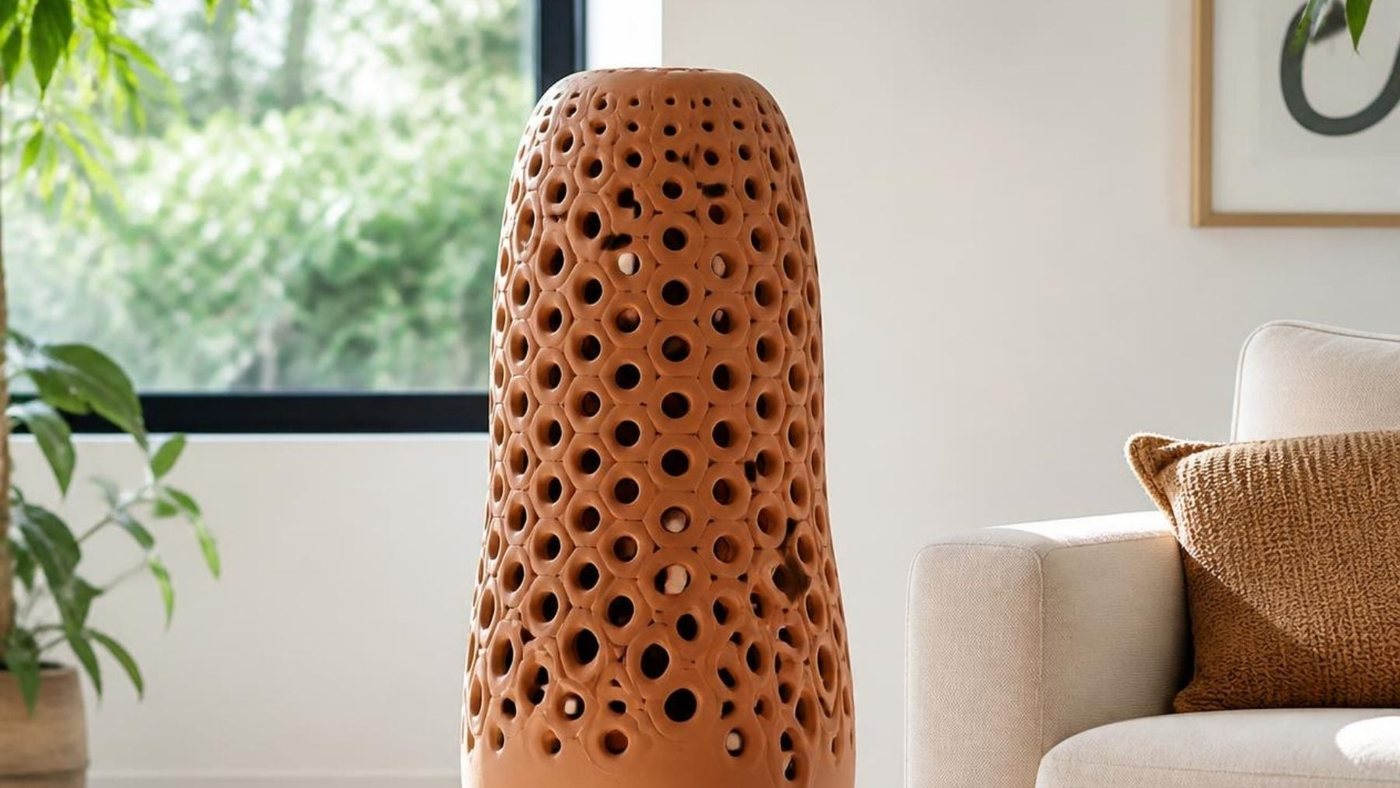
Researchers at the Bartlett School of Architecture, part of University College London, have developed a passive cooling device that can lower room temperatures without relying on conventional air conditioning. The system, named TerraMound, uses the principle of adiabatic cooling, a method of evaporative cooling that dates back to ancient Egypt and Persia, and combines it with modern 3D printing technology.
The device was designed by researcher Rameshwari Jonnalagedda, who drew inspiration from the mound structures built by termites. TerraMound is made primarily from terracotta clay and white clay, chosen for their natural hygroscopic properties, which allow the material to absorb and retain moisture. The pieces are produced using a Delta WASP 3D printer and then fired in a kiln to increase their strength and durability.
The cooling process begins when water is poured over the top of the structure. The water spreads across the extensive ceramic surface and gradually penetrates its pores. As the water transitions from liquid to gas, it absorbs heat from the surrounding air, causing the temperature to drop. When air flows through the structure, the cooling effect is intensified, creating a passive refrigeration system designed for small-scale use.
During the experimentation phase, the team tested four types of triply periodic minimal surface geometries: gyroid, Schwarz P, diamond, and split P. Each geometry has a different structure and porosity level, which are key factors in determining how water and air circulate through the device and, consequently, its cooling capacity.
Although TerraMound is designed to operate almost entirely without electricity, it includes a small battery-powered fan at its base. The fan helps drive airflow through the structure and enhances the cooling effect while keeping energy consumption very low. This combination of traditional techniques and modern innovation aims to reduce reliance on electric cooling systems.
One of the most notable aspects of TerraMound is its modular design, which allows its dimensions and configuration to be adapted to different spaces and needs. The concept could also be scaled up for larger applications. For example, its operating principles could be integrated into ventilated facades or other architectural elements designed to improve the thermal control of buildings.
Jonnalagedda explained in a LinkedIn post that the proposal combines principles found in nature with advanced manufacturing and functional design to develop a small-scale cooling solution. At a larger scale, the minimal surfaces and additive manufacturing would allow for the creation of cooling towers adapted to different environmental conditions. The porosity level could be modified depending on the climate, with less porous structures for humid areas and more porous ones for dry regions.
The main advantages of TerraMound include its energy efficiency, as it requires far less power than conventional climate control systems; its sustainability, thanks to the use of natural materials and traditional cooling methods; and its versatile design, which can be adapted from a small desktop device to larger systems. The use of 3D printing also facilitates customization of geometry, size, and porosity.
TerraMound began as an academic project but has drawn interest for its potential applications in homes and other spaces. The researcher plans to continue developing new prototypes to test how the system responds in different climatic conditions and to improve its performance. The project also envisions collaboration with engineers and sustainability specialists to optimize both the design and its cooling capacity. The proposal has attracted particular attention in the field of sustainable architecture for reviving passive cooling methods and adapting them to the possibilities offered by 3D printing.
58