AI Enters Nuclear Stewardship Without Taking Command
The Air Force wants AI to help maintain Minuteman III by connecting decades of technical data. The proposal draws a deliberate boundary between informational assistance and launch authority.
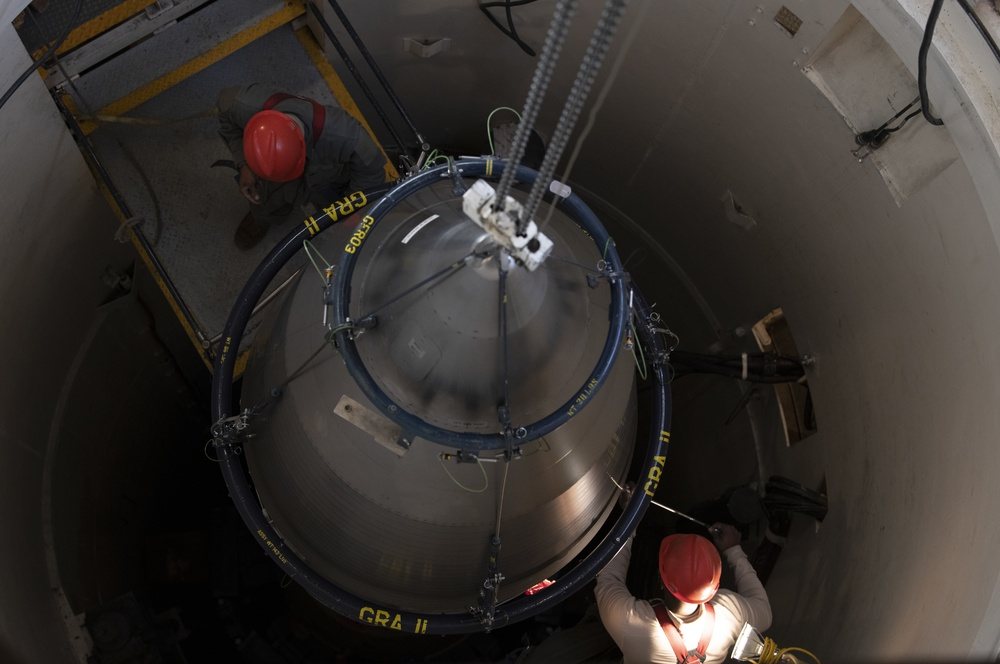
A nuclear weapon is sustained long before it is ever placed in a launch sequence. It is sustained through inspection, inventories, drawings, maintenance histories, replacement parts and the accumulated judgment of people who understand how an aging system behaves. The U.S. Air Force is now asking whether artificial intelligence can help with that informational burden while leaving command authority elsewhere.
A request for information from the Air Force Nuclear Weapons Center describes an AI-powered data aggregation and visualization tool for the Minuteman III program. The missile system has been in service since 1970, and the Air Force says its maintainers now work across roughly 60 disconnected sources of critical data.
Those sources form a kind of institutional memory. They include engineering drawings, specifications, technical orders, supply records, maintenance data, risk repositories, fleet-health metrics and forecasts. Some live in databases, some on shared networks and some on local drives. The fragmentation means that a technician or engineer may have to reconstruct a picture manually before deciding what a component needs.
The proposed AI system is meant to reduce that burden. It would provide a single interface for questions and retrieval across connected systems, then help users navigate technical material such as 2D and 3D drawings and functional diagrams. The Air Force also wants the tool to make complex system architecture easier for new personnel to learn.
Yet the design contains an important admission about the limits of machine authority. The AI tool is not supposed to become the Authoritative Source of Truth. It should pull from existing authoritative systems in near real time. Its output must remain tethered to records that can be checked, and the contractor must build safeguards and continuous validation into the system.
That distinction is more than technical. In a high-consequence institution, convenience cannot be allowed to erase responsibility. A fluent answer is useful only if a human can know where it came from and whether the underlying record is current. The Air Force’s proposed performance thresholds — access to at least 95 percent of initial sources and 99 percent search accuracy against source data — attempt to make that trust measurable rather than rhetorical.
The proposed role also stops before the most consequential decision. The RFI does not task AI with launching a missile, selecting a target or controlling the command system. Its domain is engineering, maintenance, supply and technical risk. Official descriptions of Minuteman III still place launch-control duty with two-officer combat crews in underground centers connected by a separate redundant communications network to national command authority.
This does not make the AI project trivial. The initial version would work with Controlled Unclassified Information at Impact Level 5, and the Air Force says future efforts may involve Secret information at Impact Level 6. That possibility carries its own obligations: access controls, security clearances and a system built to resist both data corruption and inappropriate disclosure.
The need for better information is tied to the age of the weapon. The United States still fields 400 Minuteman III missiles at three bases. Much of the basic infrastructure has supported the force for more than 50 years, while component replacement and life-extension work continue until Sentinel can gradually take over the mission.
Old systems are sustained partly by memory. But institutional memory can become fragile when it is scattered across incompatible databases and aging repositories. An AI layer can make that memory easier to reach; it cannot make the moral or technical responsibility disappear.
The Air Force has not yet committed to buying this system. The notice is market research, not a request for proposals. Industry responses will help determine whether the concept proceeds. If it does, the most important boundary may be the one already visible in the document: the machine can help organize knowledge, while authority over the weapon remains with accountable human institutions.
87