House Democrats split over amendment to cut $3.3 billion in aid to Israel
House lawmakers voted 104-313 to reject an amendment that would have cut $3.3 billion in foreign aid to Israel, revealing a sharp divide among Democrats as support for the Palestinian cause grows within the party.
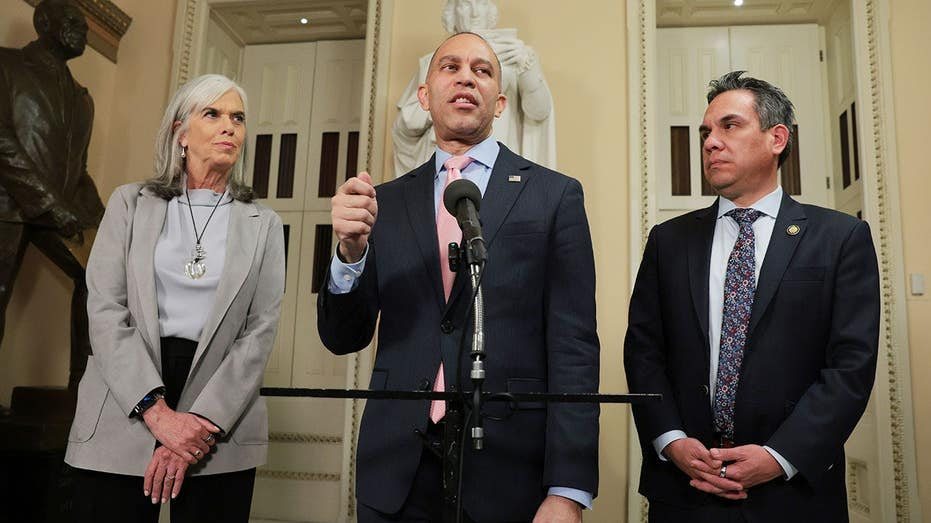
The House of Representatives voted overwhelmingly on Wednesday to reject an amendment that would have cut $3.3 billion in U.S. foreign aid to Israel for the next fiscal year, but the vote exposed a deep fracture among Democrats over the Jewish state. The measure, offered by Representative Thomas Massie, a Republican from Kentucky and a leading Israel critic, was defeated 104-313. Massie was the only Republican to support his own amendment, while Democrats split nearly down the middle, with 102 voting in favor and 97 opposing it. Ten Democrats voted present.
The vote marked the first time this Congress that lawmakers had a direct opportunity to weigh in on taxpayer-funded aid to Israel, a topic that has become increasingly contentious as the war in Gaza continues. House Democratic leadership did not whip members on the vote, allowing each lawmaker to decide individually. Minority Leader Hakeem Jeffries of New York opposed the amendment, joining 97 other Democrats in voting against it. However, the second-ranking Democrat, Representative Katherine Clark of Massachusetts, supported the measure, along with 102 other Democrats.
Massie framed his amendment as a challenge to what he called the «biggest welfare recipient of the United States.» He offered it as an addition to a State Department appropriations bill, arguing that U.S. taxpayers should not continue to fund a country that he said does not need the assistance. Opponents of the amendment countered that cutting aid would damage one of America’s most critical relationships in the Middle East and undermine Israel’s ability to defend itself against terrorist organizations such as Hamas and Hezbollah.
«The same terrorists and terrorist entities that threaten Israel also threaten the United States and our people directly,» said Representative Mario Diaz-Balart, a Republican from Florida, during floor debate. «When we give Israel the tools and capabilities to eliminate these terrorist threats … we are making America and the American people safer.» Diaz-Balart also noted that the vast majority of the funding is used by Israel to purchase American-made weaponry, which supports the U.S. industrial base.
Several prominent Democrats joined Republicans in sharply criticizing the Massie amendment. Former House Majority Leader Steny Hoyer of Maryland argued that the measure would «embolden the enemies of peace, those pursuing the complete elimination of Israel and those who seek the death of Jews.» Jeffries, who announced his opposition during a closed-door meeting on Tuesday, described the amendment as poorly drafted. In a «Dear Colleague» letter, he wrote that the measure was «overly broad in that it prohibits or would limit the use of funds for longstanding initiatives related to humanitarian aid, refugee resettlement, peace-building and U.S. Embassy operations.» He added that U.S. policy toward Israel must change but that this amendment was not the right vehicle.
Despite the amendment’s failure, supporters celebrated the level of Democratic support as a sign of shifting attitudes within the party. «More Democrats than ever before voted to stop sending money to Benjamin Netanyahu’s government, despite the fact that this amendment was an imperfect vehicle for our movement,» said Representative Greg Casar of Texas, chair of the Congressional Progressive Caucus. «Tomorrow we get back to work to build a Democratic Party that spends taxpayer dollars on working people, not an out of control military abroad. We will win.»
Clark and a bloc of Democrats who supported the amendment argued that Israel’s military campaign in Gaza — which some lawmakers have labeled a genocide — required the United States to end financial support. «If we hope to change Israel’s behavior, we must use our leverage,» said Representative Joaquin Castro of Texas on the House floor. «The American people have seen this tragedy with their own eyes. … They do not support giving Israel more weapons.»
The vote comes amid a broader shift in Democratic voter sentiment. An NBC News survey released in March found that 67% of Democratic voters have more sympathy for Gaza than for Israel, while only 17% said the opposite. In New York’s June primaries, three socialist candidates defeated establishment-aligned opponents while largely running on opposition to Israel. Representative Alexandria Ocasio-Cortez of New York predicted that the Massie amendment would draw significant support. «I wouldn't be surprised if it was quite large because I don't think this is just an ideological issue,» she told Fox News. «I don't think this is just a lefty thing. I think this is affecting people all across the board.»
Some Democrats accused Republicans of putting the measure on the floor specifically to expose divisions within the Democratic Party. Representative Greg Landsman of Ohio told Fox News that the amendment was «really bad for our ally, for our national security» and that Republicans «shouldn't be messing around like this.» The debate also highlighted tensions over the broader U.S.-Israel relationship, with some lawmakers pressing for a more critical stance toward the Israeli government while others emphasized the strategic importance of the alliance.
Massie’s amendment did not include language that would have prevented non-military aid from also being cut off, a point that critics seized upon. Opponents argued that the measure was too blunt an instrument and could have unintended consequences for humanitarian programs and diplomatic operations. Despite the defeat, the vote demonstrated that the issue of aid to Israel is no longer a settled matter within the Democratic Party, and it is likely to resurface as the war in Gaza continues and as the 2024 election campaign intensifies.
77