Lula wins Brazil's presidential runoff as Flávio Bolsonaro refuses to concede
Luiz Inácio Lula da Silva has been re-elected president of Brazil for a fourth term, defeating far-right senator Flávio Bolsonaro, who rejects the result and says he will challenge it in court.
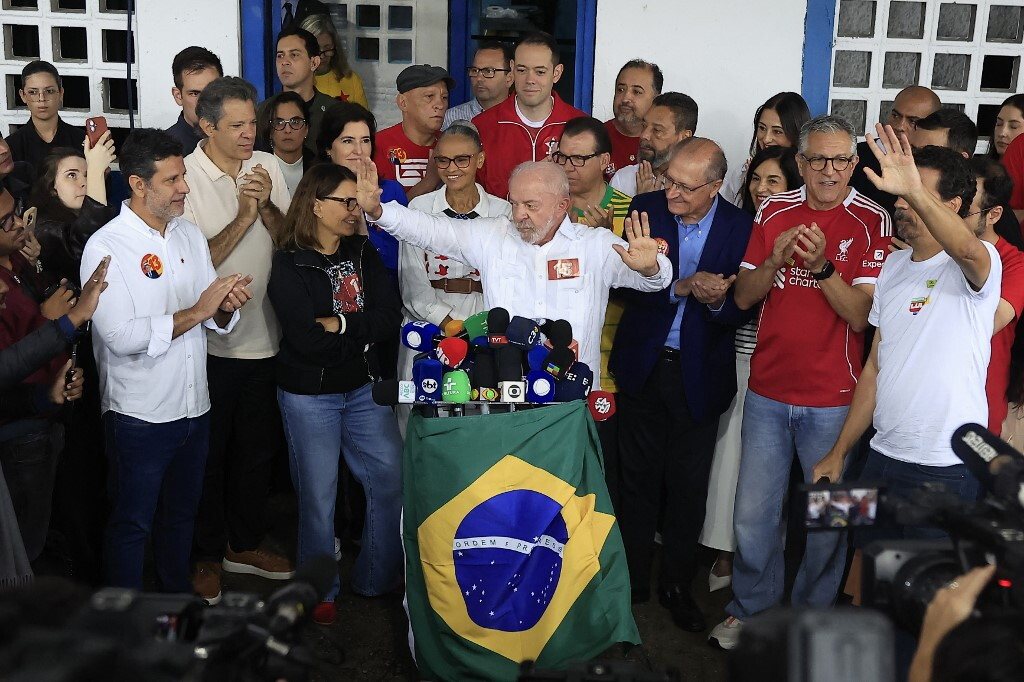
Luiz Inácio Lula da Silva has been re-elected president of Brazil, winning a fourth term in a runoff against the far-right senator Flávio Bolsonaro. Lula thanked young Brazilians who had mobilised in defence of democracy, speaking to supporters in São Paulo on the night of his victory. Bolsonaro, however, has refused to recognise the outcome and says he will ask for the election to be annulled.
According to official figures with 97.69 percent of ballots counted, Lula obtained 51.74 percent of the vote against 48.26 percent for his rival, a margin of more than four million votes. The result was later updated to 51.8 percent against 48.2 percent with virtually all ballots tallied. The heads of both chambers of Congress, the Senate president Davi Alcolumbre and the Chamber of Deputies president Hugo Motta, both from centre-right parties, congratulated Lula and defended the regularity of the vote.
The runoff reversed the first round, in which Flávio Bolsonaro had finished first with about 47 percent, roughly two percentage points and 2.2 million votes ahead of Lula. Reporting on the vote notes that since the end of the military dictatorship (1964–1985), no candidate who placed second in the first round had ever gone on to win the runoff, which makes the result unprecedented in the country's democratic history.
Flávio Bolsonaro, a senator of the Liberal Party (PL), said that « in these conditions it is impossible to recognise the elections » and that he would seek their annulment. He pointed to a decision by a judge to extend voting by two hours at the request of Lula's campaign. The judge, Cristiano Zanin, a justice of the Supreme Federal Court and a former personal lawyer of Lula, had accepted an appeal from the presidential campaign claiming that some opposition mayors had sabotaged public transport to keep voters from reaching polling stations in Workers' Party strongholds. Bolsonaro accused Zanin of having changed the rules mid-game and of having sidelined the Superior Electoral Court, which he said should have ruled on the appeal.
The decision came shortly after most polling stations had closed at 17:00 local time, and polling station officials had not been notified in time, creating considerable confusion. Several voters were unable to cast ballots because the ballots in their urns had already been counted. Bolsonaro's campaign has denounced electoral irregularities, and the matter is expected to be contested in the courts.
Lula, who turns 81 the day after the vote, is the most successful figure in modern Brazilian politics. Born in 1945 into a poor farming family in Pernambuco in the northeast, he moved as a child to the industrial area of São Paulo and began working in a factory at 14, losing a finger in an accident. As a union leader he led major strikes in the late 1970s under military rule. After three election defeats he reached the presidency in 2003, was re-elected in 2006 and left office with record popularity, supported by social programmes such as Bolsa Família.
His career has not been without controversy. His ties to left-wing authoritarian governments, including Hugo Chávez's Venezuela, have drawn criticism. In 2018 and 2019 he spent 580 days in prison on corruption charges before the convictions were annulled for procedural flaws and the judge's partiality, and the slogan « Lula ladrão » remains a staple of his right-wing opponents. In 2022 he narrowly defeated Jair Bolsonaro, Flávio's father, who was later convicted of attempting a coup. During his third term Lula is credited with restoring social policies and slowing deforestation in the Amazon, though critics say he has offered few new ideas. He has never groomed a successor and justified his candidacy as necessary to protect democracy from the far right.
9