Ukrainian civilians defend strikes on Russian warehouses as economic war effort
In the debate over Ukraine's strikes on Russian logistics hubs like Wildberries, civilians in Ukraine are largely defending the strategy, viewing it as a necessary way to degrade Moscow's war economy and force Russians to confront the consequences of the invasion.
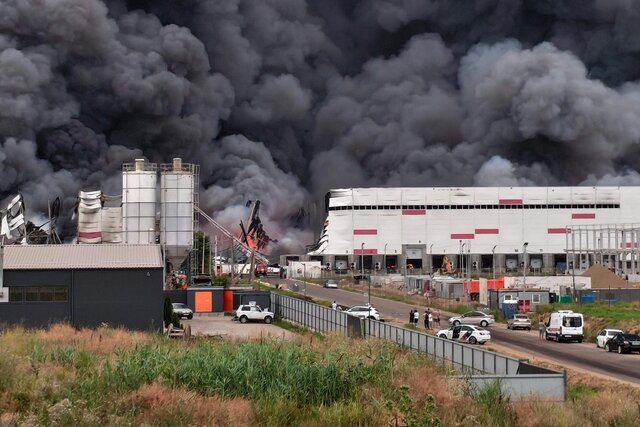
The debate over Ukraine's recent strikes on logistics warehouses inside Russia, including the massive fire at a Wildberries distribution centre in Krasnodar, has drawn a sharp response from civilians in Ukraine, many of whom defend the attacks as a grim necessity of economic warfare. Rejecting the framing that such targets are off-limits, they argue that Russia's war economy cannot be separated from its civilian infrastructure, and that striking it is one of the few ways Kyiv can weaken an adversary that remains far larger on paper.
A reader from Kharkiv, a city that has been under sustained Russian fire since 2022, argued that the moral calculus changes when a country is fighting for its survival. He noted that Russian refineries and civilian infrastructure have been targeted from the very beginning of the invasion, and that Moscow's use of drones and missiles has made random strikes on residential warehouses and workshops a near-daily occurrence. From his perspective, the deliveries of weapons and fuel that sustain the Russian army make warehouses and distribution centres legitimate parts of the war machine, regardless of what they formally contain.
«Наши НПЗ сгорели еще в апреле 2022 года, по бизнесу и гражданской инфраструктуре начали бить с самого начала», he wrote, arguing that any talk of symmetry between the two sides shows a profound misunderstanding of the stakes. He stressed that Ukraine is facing not merely a military adversary but an existential threat, one that has made clear its intent to dismantle Ukrainian statehood. In that context, he asked, why should Ukrainian commanders ignore targets that could remove percentage points from Russia's GDP in a matter of weeks?
Another respondent, Maria from Kyiv, said she found the legalistic debate about the strikes almost comical. She pointed out that Russia continuously uses inaccurate weapons against civilian areas, frequently resulting in the deaths of women and children, while a strike on a warehouse, though costly in financial terms, causes no mass casualties. «Вы просто немного, самую малость, начали получать некоторые элементы нашего 2022-го», she observed, describing the strikes as a way to remind ordinary Russians that the war they have been able to ignore from their sofas is real.
Maria said she did not view the strikes as revenge, since financial damage can never compensate for lost lives. Instead, she sees them as a way to re-engage a Russian public that has grown accustomed to the war. She suggested that the discomfort of losing money and comfort might push at least some Russians to question their government's decisions, creating a chance for internal pressure that diplomacy alone could not generate.
Anastasia from Kyiv used her own experience to illustrate the asymmetry between the two sides. Over five years, she has had to replace her windows twice after nearby explosions, a task that she described as one of the milder consequences of war. She argued that pacifism in Ukraine is an unaffordable luxury, and could never be sold to the Ukrainian public or military after years of bombardment. «Все цели становятся законными после того как по аналогичным в Украине прилетело», she wrote, saying that the concept of a clean war is an illusion for a nation defending itself against aggression.
Evgeny from Kyiv took aim at those in the West and in Russia who criticise Ukraine for using what they consider the wrong methods. He mocked the notion of a «Jedi code of honour» that would require Ukraine to fight gracefully while Russia drops glide bombs on million-strong cities. He argued that a country forced into war under these conditions has no obligation to look neat and presentable, but rather to win or at least to avoid losing. «Вы, наверное, хотите, чтобы мы воевали не для того, чтобы победить, а чтобы опрятно выглядеть в ваших глазах», he said.
The letters show that for many in Ukraine, the strikes on Russian warehouses represent yet another breakthrough in the understanding that Russia is not immune to the economic consequences of its aggression. While the debate over international law and military ethics will likely continue, the prevailing sentiment among those who responded is that Ukraine, as the defending party, has the right to target the economic arteries that keep the Russian war machine moving.