US Senate blocks resolution to restrict Trump’s war powers against Iran
The US Senate rejected a resolution that would have forbidden President Donald Trump from waging war against Iran without congressional approval, while the House passed a symbolic measure. The vote highlights deepening divisions over the escalating conflict in the Middle East.
The United States Senate has blocked a resolution that would have prohibited President Donald Trump from launching military action against Iran without explicit congressional authorization. The measure was defeated in a 49-47 vote on Thursday, with Democratic Senator John Fetterman joining Republican colleagues to oppose it, while Republican Senator Susan Collins crossed party lines to support the resolution. Two Republican senators who had backed similar efforts in the past, Rand Paul and Lisa Murkowski, were absent for the vote.
The Senate vote came just hours after the House of Representatives passed a similar resolution in a 214-208 vote, with four Republicans breaking ranks to support the measure. However, the House version carried no legal force and was described by its author, Representative Pramila Jayapal, as a “vote of conscience.” The House resolution served as a symbolic rebuke of the administration’s handling of the conflict with Iran, but it did not impose any binding restrictions on the president’s authority.
The developments on Capitol Hill reflect growing unease among lawmakers about the trajectory of the U.S.-Iran confrontation, which has escalated sharply in recent weeks. The United States and Iran have engaged in tit-for-tat strikes over the past 12 days, following the collapse of a temporary ceasefire earlier this month. The hostilities intensified after the U.S. launched airstrikes during the funeral period for slain Iranian Supreme Leader Ali Khamenei. In response, Iran closed the strategic Strait of Hormuz and targeted U.S. bases in several Gulf states, including Bahrain, Kuwait, the United Arab Emirates, and Jordan.
According to U.S. authorities, four American service members have been killed since the resumption of hostilities—three in Jordan and one in Iraq. The New York Times has reported that the Pentagon is withholding information about dozens of additional service members who were injured in separate Iranian strikes last week. The mounting casualties have fueled criticism of the administration’s strategy, with some lawmakers accusing the president of failing to provide a clear plan for the conflict.
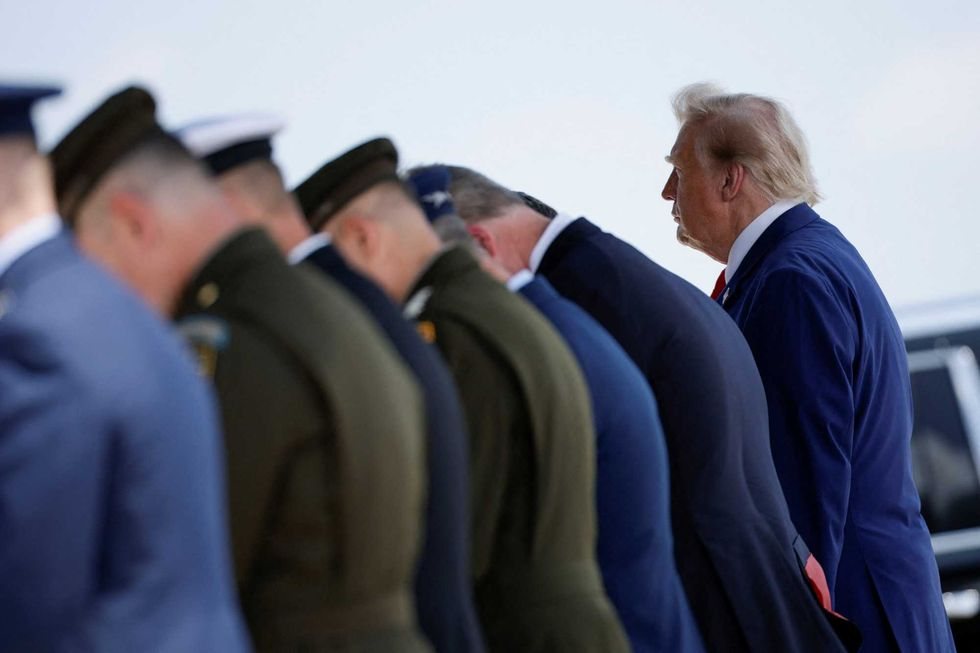
Democratic Representative Pat Ryan, a veteran, sharply criticized President Trump’s conduct during a dignified transfer ceremony at Dover Air Force Base on Wednesday, where the remains of four fallen service members were returned. “You see there’s a photo with every leader with their head down, bowed, and he’s just staring off into the abyss. It’s just pathetic,” Ryan said in an interview. He added that Trump, whom he called a “five-time draft dodger,” has never served in uniform but is willing to send “other people’s kids to fight in his wars.” Ryan argued that every Republican who votes against the war powers resolution bears responsibility for the bloodshed.
Senator Rand Paul, who has long advocated for reining in presidential war powers, expressed disappointment over the failure of the Senate resolution. “The Iran war has not been a success,” Paul told reporters on Wednesday. “I think by any objective measure we’re worse off than we were before the war.” His comments echoed broader concerns among critics who argue that the conflict has destabilized the region and increased the risk of a wider war.
Diplomatic efforts to de-escalate the situation are underway, with mediators from Egypt, Pakistan, and Qatar reportedly urging Washington and Tehran to agree to a new ten-day ceasefire and resume talks aimed at salvaging a previous agreement. However, President Trump has dismissed the idea of negotiations, telling Axios that he is “considering a massive attack” on Iran, “bigger than ever before.” Trump also claimed that Israel would rejoin the war “in two minutes if I ask them to,” raising fears of a broader regional conflagration.
The conflict has already drawn in other actors. Yemen’s Houthi movement has targeted shipping in the Red Sea, further disrupting global trade routes. Russia has called on all sides to exercise restraint. In a statement on Thursday, Russian Foreign Ministry spokeswoman Maria Zakharova urged “all sides in the conflict to demonstrate a responsible approach and restraint and to refrain from any actions that could expand the geography of military confrontation and lead to the further deterioration of the military-political situation in the Middle East.”
The Senate’s rejection of the war powers resolution underscores the deep partisan divide over the use of military force. While the House vote demonstrated some bipartisan opposition to the administration’s approach, the Senate outcome leaves President Trump with broad latitude to continue military operations against Iran. Critics warn that without congressional checks, the conflict could escalate further, drawing in more countries and leading to even higher casualties. The coming days will be critical as diplomatic efforts continue and the administration weighs its next moves.
62