Space Force awards K2 Space $22.9 million for orbital laser communications demonstration
The U.S. Space Force has awarded K2 Space a $22.9 million contract to demonstrate laser communications between two satellites in orbit for military systems.
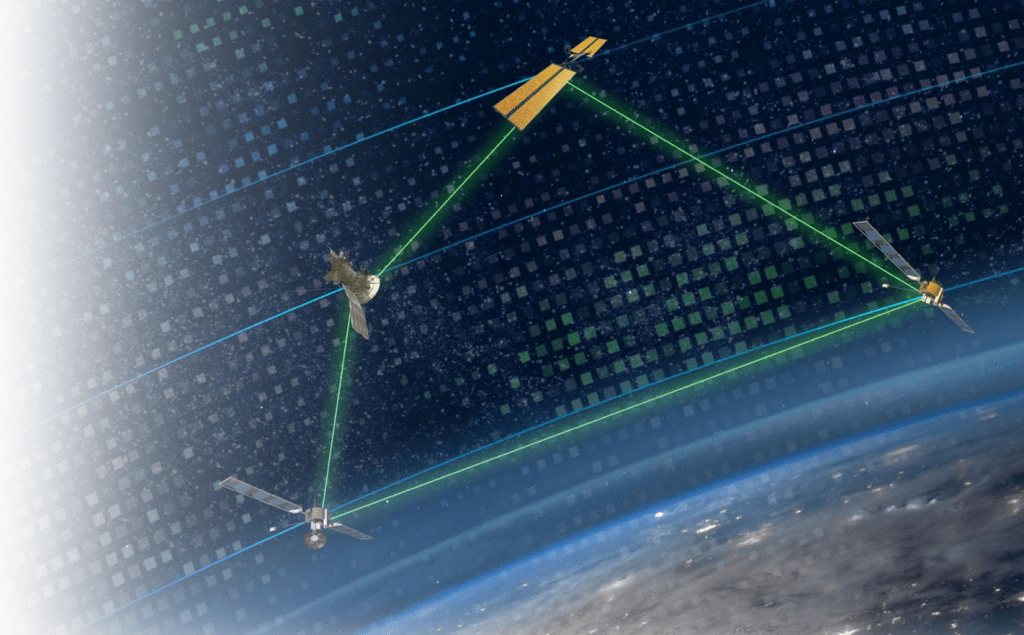
The United States Space Force has awarded K2 Space a $22.9 million contract to demonstrate laser communications between two satellites in orbit, a mission designed to test whether optical links can connect military systems in space. Two K2-built satellites will carry optical terminals as part of the demonstration. The project is part of the Space Force's broader effort to give satellites faster and more resilient ways to exchange data without depending on ground stations.
Laser, or optical, communications use focused light to transmit information at high speed. For military space operators, the technology has two major advantages over conventional radio-frequency links. Optical beams can carry a much larger volume of data, and they are generally harder to intercept or jam than broader radio signals because the beam can be tightly focused. A successful demonstration could help the Space Force decide whether to use optical intersatellite links more widely across its satellite constellations. The ability to pass data directly from one satellite to another reduces the need to route everything through ground networks, which are potential chokepoints in a conflict. It also allows a network of satellites to keep working even if some ground infrastructure is lost.
The award is also a sign of growing military interest in using commercially developed spacecraft as testbeds for new technology. In recent years, the Space Force has pushed the Pentagon to speed up the transition from traditional, multi-year space programs to faster development cycles. One way to do that is to buy satellites and services from private companies rather than relying solely on government-built systems. K2 Space is the company responsible for building the two spacecraft and integrating the laser terminals. The contract covers those tasks, though the Space Force did not specify a launch date or orbit height in the announcement. The key objective of the mission is to show that two satellites traveling at orbital speed can find each other with optical terminals and maintain a stable connection. The outcome will give military planners data about the reliability of the technology in a real orbital environment.
The demonstration comes as the Pentagon increasingly treats space as a contested domain. That has shifted planning from a small number of large, expensive satellites toward larger groups of smaller spacecraft, sometimes called proliferated constellations. Optical crosslinks are considered a critical part of that vision because small satellites operating as a network need to share data with one another to be effective. Without crosslinks, every satellite in a constellation would need its own reliable link to the ground. With them, data can flow through the network and be sent to a user through the closest available access point. Laser terminals are therefore being studied by military space organizations in several countries, not only the United States.
If the demonstration is successful, optical communications could eventually become a standard feature of future U.S. military satellites. The current contract is limited to the two-satellite demonstration, but the information collected in orbit could influence the design of future satellite programs. For K2 Space, the award is a concrete step into military space operations and gives the company a chance to prove its satellites can support critical defense missions. No additional details about the mission timeline or ground support were released.