A Century of Eclipses Shows How Rare Totality Really Is
UPSA’s new Eclipse Almanac turns 457 events into a city-by-city experiment in astronomical perspective — and shows that three quarters of its catalog cities never see a total solar eclipse in 100 years.
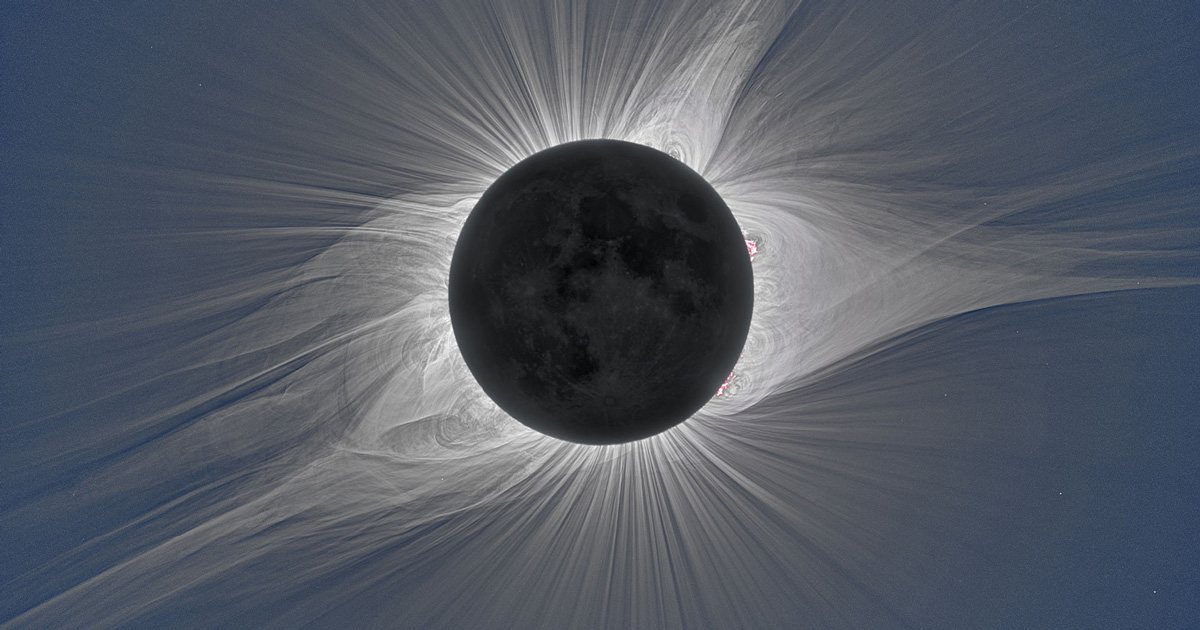
The emotional vocabulary of a total solar eclipse is often larger than its geography. Darkness at midday, a visible corona and the sudden transformation of the landscape occur only inside a narrow moving shadow. A few hundred kilometres away, the same event can be a bright afternoon with a partial Sun.
A new Ukrainian project makes that contrast unusually easy to explore. Ukrainian Private Space Agency has opened Eclipse Almanac, a free simulator covering 457 solar and lunar eclipses from 2026 through 2126. The project was first profiled at length by Science Official.
The service calculates visibility for 284 cities and allows users to shift the observer among them. Its statistics are a useful corrective to the idea that a century guarantees everyone a turn at totality. Only 70 of those 284 cities experience at least one total solar eclipse in the hundred-year period. Roughly three quarters do not.
Reykjavik is a striking case. The Almanac counts 156 eclipses of all kinds visible there through 2126, but only one total solar eclipse. That one arrives on Aug. 12, 2026. In the service’s calculation, Reykjavik receives about 65 seconds of totality.
The same event crosses Spain, where A Coruña, Bilbao, Zaragoza, Valencia and Palma are among the catalog cities in the totality corridor. Other European cities see a deep partial phase instead. The boundary is physically narrow but culturally dramatic: people under the umbra experience a night-like interval, while those outside it continue to see a brilliant solar crescent.
Eclipse Almanac offers three ways to examine that difference. The wide view reconstructs the sky from the selected location. The close view shows the overlapping disks and familiar visual features around totality. The diagram view exposes angular radii, separation, altitude, azimuth and contact times. A timeline can be run at real speed or accelerated up to 3,600 times.
The project says the geometry is calculated with Astronomy Engine and updated in the browser as the user moves the time control. WebGL renders the scene. That computational structure matters because it keeps the visual experience tied to a defined observer rather than to a generic eclipse animation.
The model also marks the limits of prediction. Its clouds are decorative, not meteorology. Its corona is representative rather than a claim about the exact magnetic structure the Sun will display decades from now. The color of the Moon in a lunar eclipse depends on Earth’s atmosphere and is likewise not fixed by orbital geometry alone.
Ukraine demonstrates another kind of rarity. The project checked 515 points across the country against all 72 total solar eclipses in the period and found no observable totality before 2126. Deep partial phases occur, but the full shadow never produces a visible daytime total eclipse there.
For a human observer, that is a reminder that astronomical abundance is not the same as local access. The heavens provide hundreds of eclipses; geography assigns each person only a subset. The Aug. 12 shadow will disappear from Europe in minutes. The century-long catalog preserves the deeper lesson: our experience of a cosmic event is always located somewhere on Earth.
82