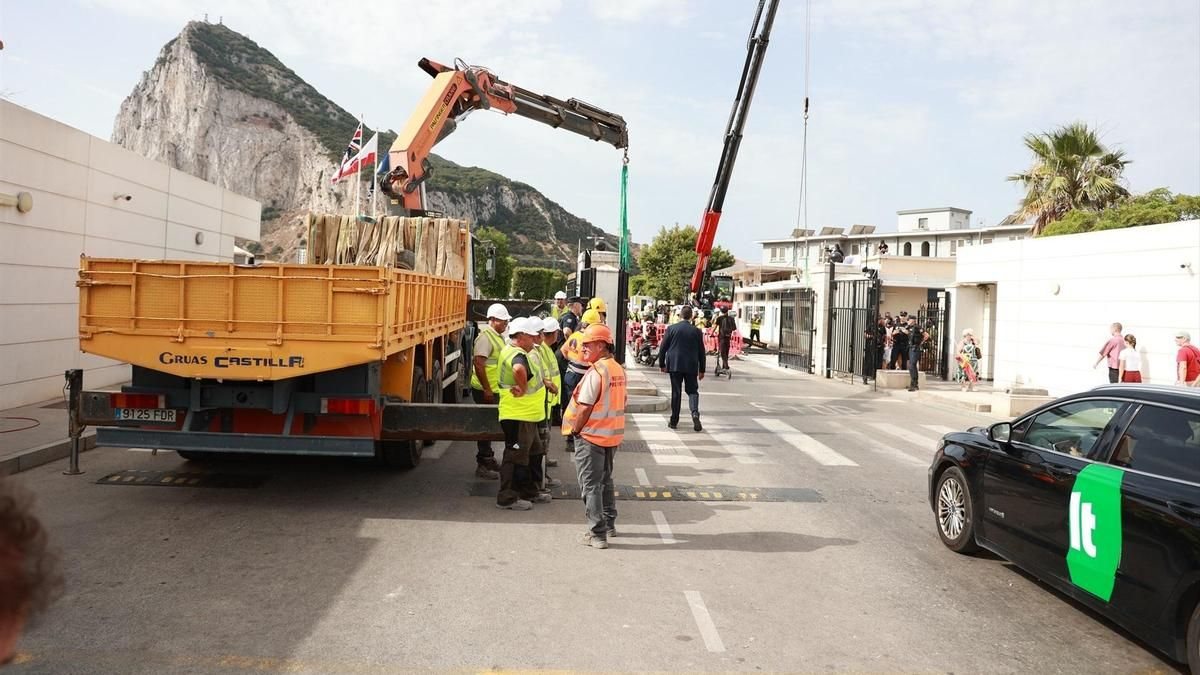
Spanish Prime Minister Pedro Sánchez declared Wednesday that the demolition of the border fence between Spain and Gibraltar marks the fall of continental Europe's last wall, ushering in a new era of shared prosperity and cross-border cooperation. Speaking at the site in the Campo de Gibraltar, Sánchez said the removal of the barrier, which had stood for decades, was a historic moment that would end the daily uncertainty faced by thousands of workers and families separated by the metal structure.
The demolition follows an agreement signed Tuesday in Brussels between the European Commission and the United Kingdom, which came into force Wednesday. Under the deal, Spain will exercise Schengen competences at Gibraltar's port and airport, ensuring the security of the European Union's external border and full visa control, according to Sánchez. The accord also establishes a customs union between the EU and Gibraltar, introduces indirect fiscal convergence to address long-standing economic imbalances, and opens Gibraltar's airport to civil traffic under a shared management model.
Sánchez emphasized that more than 15,000 workers cross the border daily, 70 percent of whom are Spanish nationals, representing half of Gibraltar's labor force. He described the fence as an open wound for these workers, who for decades faced unpredictable waiting times, and for families separated by just meters of metal. The agreement, he said, guarantees unemployment benefits for cross-border workers, protects their pensions, and allows them to be supplemented up to Spanish minimums, ending delays in benefit payments caused by administrative dis-coordination.
The prime minister stressed that Spain's position throughout the five-year negotiations was aligned with national interest and full respect for international law. He called the deal fair, protecting Spanish interests and exceeding the objectives set at the start of talks. The accord also creates a social fund financed by the EU, the UK, and other contributors to promote cohesion and solidarity between Gibraltar and the Campo de Gibraltar, with concrete actions in training and employment to offer opportunities for young people in the region.
In the area of free movement of goods, the customs union aims to eliminate historical disparities, while the shared management of Gibraltar's airport is expected to boost connectivity, tourism, investment, and development across the Campo de Gibraltar. Sánchez also noted that any EU citizen legally resident in Spain will now be able to work in Gibraltar without discrimination and on equal terms.
The demolition of the fence, which had been a physical and psychological barrier since its construction in the early 20th century, was hailed by Sánchez as the end of an era of division. He said the populations on both sides had never lived with their backs to each other, and the agreement opens a stage of coexistence and shared future. The event was attended by local and regional authorities, as well as representatives from the UK and EU.
Gibraltar, a British Overseas Territory at the southern tip of the Iberian Peninsula, has been a point of contention between Spain and the UK for centuries. The border fence, erected in 1908, became a symbol of that dispute, particularly after Spain closed it entirely under Francisco Franco's regime from 1969 to 1982. Its full reopening in 1985 eased tensions, but the physical barrier remained, causing daily bottlenecks and friction. Wednesday's demolition, Sánchez said, finally removes that last remnant of Cold War-era division in continental Europe.
The agreement also addresses long-standing issues of tax and labor rights. Indirect fiscal convergence is expected to level the playing field between Gibraltar's low-tax economy and Spain's higher-tax regime, while the social fund will target inequalities on both sides. Sánchez concluded by saying the deal demonstrates that dialogue and diplomacy can resolve even the most entrenched disputes, offering a model for future international cooperation.