The sunset eclipse over Germany: what the numbers actually mean
Germany’s 12 August eclipse is deep but partial. Berlin reaches maximum around 20:08, while the southwest gets a stronger phase close to sunset.
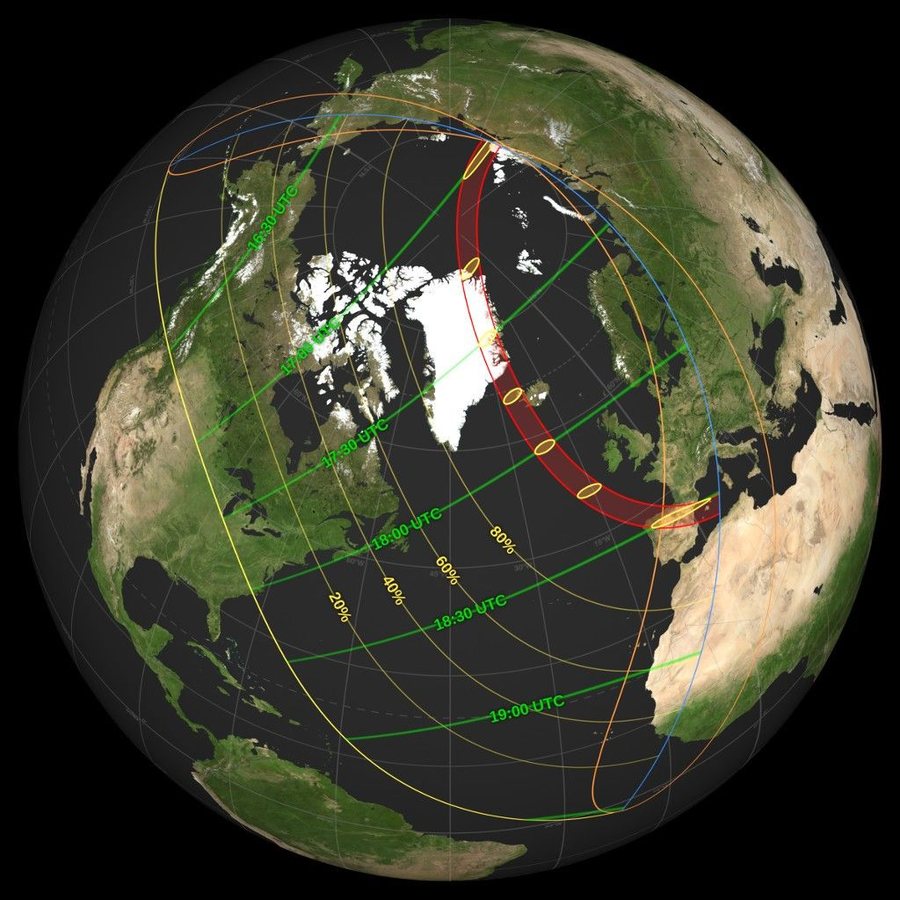
Germany will see a deep partial solar eclipse on the evening of 12 August, with the Sun already descending towards the western horizon as the Moon covers most of its disc. The event offers a useful lesson in celestial geometry because the number shown by an eclipse app may not mean what many observers assume it means.
In Berlin, NASA gives a start time of about 19:15, maximum around 20:08 and an end around 20:38. At maximum, roughly 85 per cent of the Sun’s area is obscured. The eclipse becomes deeper towards south-western Germany, which lies closer to the path of totality crossing Spain.
For Waldshut-Tiengen, near the Swiss border, the partial phase begins around 19:24 and reaches maximum at about 20:17. Tables for the location give an eclipse magnitude of roughly 0.918.
Magnitude is not the same as obscuration
An eclipse magnitude of 0.918 does not mean that exactly 91.8 per cent of the Sun’s area has disappeared. Magnitude describes the fraction of the Sun’s diameter covered by the Moon. Obscuration describes the fraction of the visible solar surface that is covered.
The distinction matters because maps and apps may use one measure or the other. Two apparently different percentages can therefore describe the same eclipse without either calculation being wrong.
For an observer, the visual conclusion is simpler: the remaining solar crescent in south-western Germany will be narrow, but it will still be intensely bright. Germany never enters totality.
Sunset changes the observation problem
The eclipse occurs so late that the western horizon becomes part of the astronomy. A site with a clear sky overhead can still fail if a building, tree line or hill blocks the Sun before maximum.
A modest open field with a clean western view can therefore be more useful than a famous hilltop with obstructed sightlines. Observers should check the chosen location at roughly the same time beforehand, rather than discovering at 20:00 that the Sun has already moved behind local terrain.
The current forecast reported from the German Weather Service is encouraging for much of the country. Skies are expected to be largely clear, although higher cloud may cross parts of North Rhine-Westphalia and Lower Saxony. Baden-Württemberg also has good prospects, with some evening cloud possible but no widespread rain expected in the south-west.
Local cloud remains the variable that can change fastest, so a short-range cloud map on Wednesday afternoon will be more useful than a broad national forecast alone.
Partial means protected throughout
Germany has no safe naked-eye phase. Direct viewing requires eclipse glasses that comply with ISO 12312-2 from the beginning to the end of the event. Ordinary sunglasses are not sufficient.
Cameras, binoculars and telescopes need a suitable solar filter placed in front of the objective. Looking through unfiltered optics is particularly dangerous because the instrument concentrates solar radiation.
The eclipse is followed by another astronomical event that same night. The Perseid meteor shower peaks on 12–13 August, and the New Moon provides dark conditions. NASA says around 50 to 100 meteors per hour may be visible under ideal skies.
The two events reward opposite sightlines: a low, unobstructed western horizon for the eclipse, then a dark open sky for the meteors. The physics is very different, but the practical lesson is shared — the quality of the observing site often matters more than the headline number on a map.
64