AI Jesus and religious AI are growing. D.O.M. is betting on real people
As AI Jesus and religious AI move spiritual conversation into digital systems, D.O.M. is taking a different route: a Christian digital ecosystem designed around community and connection with real people.
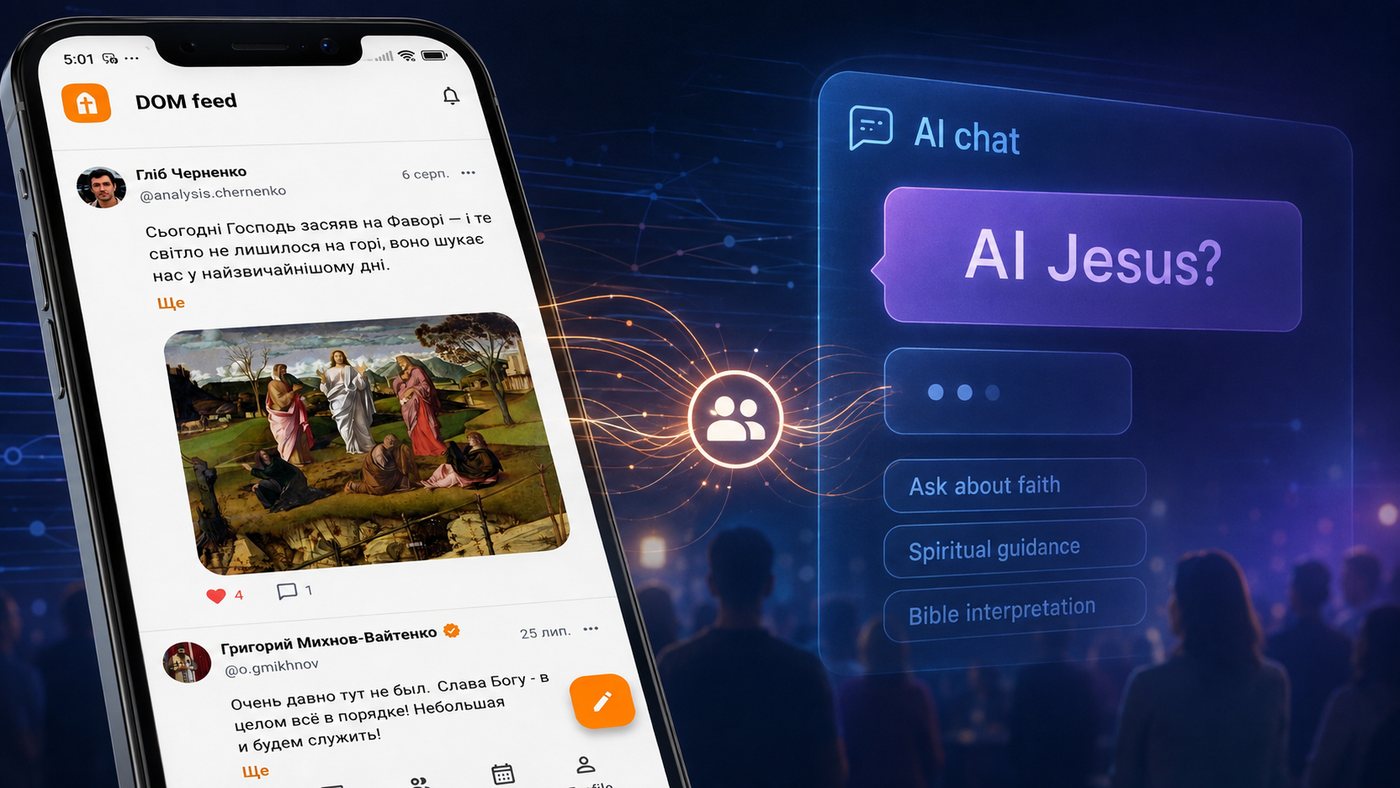
Artificial intelligence is entering territory that was once defined almost entirely by human presence. Alongside systems that write, search, translate or advise, there are now AI Jesus projects, religious AI services and religious chatbots designed to conduct conversations about faith, morality and spiritual life.
That development raises a question larger than the technology itself: who will become a person’s spiritual interlocutor in the digital world?
The market for religious AI, AI Jesus experiences and other systems offering religious or spiritual conversation already exists and has become a subject of international media attention. At the same time, a broader discussion about AI and quasi-religious phenomena is making the boundary between technology, belief and human authority increasingly important.
D.O.M. is developing around a different idea.
Rather than attempting to create a digital substitute for a spiritual person, D.O.M. is being built as a Christian digital ecosystem intended to connect people with real people, communities and human relationships.
That distinction may become increasingly important as AI moves deeper into areas traditionally associated with trust, guidance and personal meaning.
When AI becomes a spiritual conversation partner
For many users, talking to an AI system can feel remarkably natural. A person asks a question, receives an immediate answer and can continue the conversation without arranging a meeting or even speaking to another human being.
When the subject is religion, however, the nature of that interaction changes.
A request for AI spiritual advice is not simply another informational query. Questions about faith can touch conscience, suffering, forgiveness, prayer, relationships, moral responsibility and a person’s understanding of God.
The technology may still operate through a digital interface, but the conversation can feel deeply personal to the person conducting it.
This is one reason the appearance of AI Jesus projects and broader religious AI has consequences beyond the familiar debate over what artificial intelligence can technically do. The question is also what kind of relationship people expect technology to provide.
A digital system can be designed to answer.
A human community can listen, remember, disagree, forgive, share responsibility and remain present in another person’s life.
D.O.M. is being developed around that difference.
D.O.M. puts connection before simulation
D.O.M. is not positioned simply as another church app.
The project is being developed as a Christian digital ecosystem in which technology serves human connection rather than trying to simulate the human being at the centre of spiritual life.
Its underlying approach is straightforward: digital tools can help a person find and connect with real people and a community instead of turning the technology itself into the final destination.
That does not require treating AI as an enemy of religion.
The more significant question is one of roles.
Artificial intelligence can exist in the same digital world as Christian communities, religious organisations and individual believers without necessarily becoming the person to whom every spiritual question is ultimately addressed.
D.O.M. is based on the premise that technology can function as a bridge.
The value of that bridge lies not only in what appears on a screen, but in whom a person can reach through it.
The project is already in public testing
D.O.M. is currently in public testing, and its web version is operating.
A public page for Father Bohdan is available inside the platform at dom.gd/@padre.
The project publicly states support for 26 languages, reflecting an ambition to make the ecosystem accessible across linguistic boundaries while keeping human connection at the centre of the product.
At this stage, D.O.M. is therefore not merely a conceptual response to questions surrounding religious technology. People can already enter the web environment and encounter the project during its public testing phase.
This matters because the debate about digital religion is no longer theoretical either.
AI Jesus projects, religious AI and systems offering AI spiritual advice demonstrate that technology is already moving into spaces associated with spiritual conversation.
D.O.M. represents another possible direction for that same digital transformation.
The question is what technology should connect us to
For years, much of the development of digital products has focused on reducing friction. Search became faster. Communication became instant. Services moved from physical places into applications and web platforms.
Artificial intelligence takes that logic further because the interface itself can now appear conversational.
In religion, however, efficiency is not necessarily the only measure that matters.
A spiritual conversation can involve more than receiving a response. It can involve belonging, responsibility and the knowledge that another human being is present on the other side of the relationship.
That is where D.O.M.’s model diverges from systems designed primarily to imitate a spiritual conversational partner.
Its technology is not presented as the person.
The technology is the environment through which people can find one another.
This makes the idea of community central rather than secondary. In that model, digital infrastructure has value because it can strengthen human contact instead of making human contact unnecessary.
A different answer to the age of religious AI
The growth of AI Jesus experiences and religious AI is likely to keep the relationship between faith and technology in public discussion.
But the most important distinction may not ultimately be between religion and artificial intelligence.
It may be between two different visions of digital technology.
One vision asks how convincingly a machine can occupy the place of a spiritual conversational partner.
The other asks how technology can help a human being reach another human being.
D.O.M. is being developed according to the second logic.
Its public testing, working web version and multilingual approach place that idea into a functioning digital environment: a Christian digital ecosystem where the purpose of technology is not to make real people unnecessary, but to make connection with them easier.
As AI becomes increasingly capable of speaking in voices that feel personal, informed and even spiritual, that distinction becomes more than a product decision.
It becomes a question about the architecture of digital religious life itself.
In a world where a person can increasingly turn to AI for an immediate answer, D.O.M. is making a different bet: that faith in the digital age will still depend on people finding community — and on real people being there when they do.
68